Asset Registry WP Registry grade A. No security issues foundWP RegistryNo security issues foundOpen the reportA
Asset / Equipment Registry: a custom WordPress plugin with dedicated database tables, role-based access control, a responsive front-end grid with filters and search, server-side PDF spec sheets, and secure authenticated attachments.
Install
Upload it under Plugins → Add New Plugin → Upload Plugin, then activate.
Install straight from GitHub with WP-CLI:
wp plugin install https://github.com/warezor-ua/wp-asset-registry/releases/download/v1.0.3/asset-registry-v1.0.3.zipA portfolio-grade WordPress plugin implementing a generic Asset / Equipment Registry. It pairs a custom database table and a role-based capability model with a responsive front-end grid, a custom REST API, server-side PDF spec sheets, and secure authenticated file delivery, built on a pure-logic-first architecture with a comprehensive unit-test suite and continuous integration.
Live demo
A live, read-only demo is available at asset-registry.mediacreator.agency.
The front page is the live asset grid. A demo bar offers one-click sign-in as either role:
- Registry Manager - full asset CRUD inside the WordPress admin.
- Registry Viewer - read-only access to all asset fields.
A logged-out visitor sees the public preview, which exposes only an asset's name, category, and status. The sample data resets daily, so the demo can be explored freely.
Screenshots
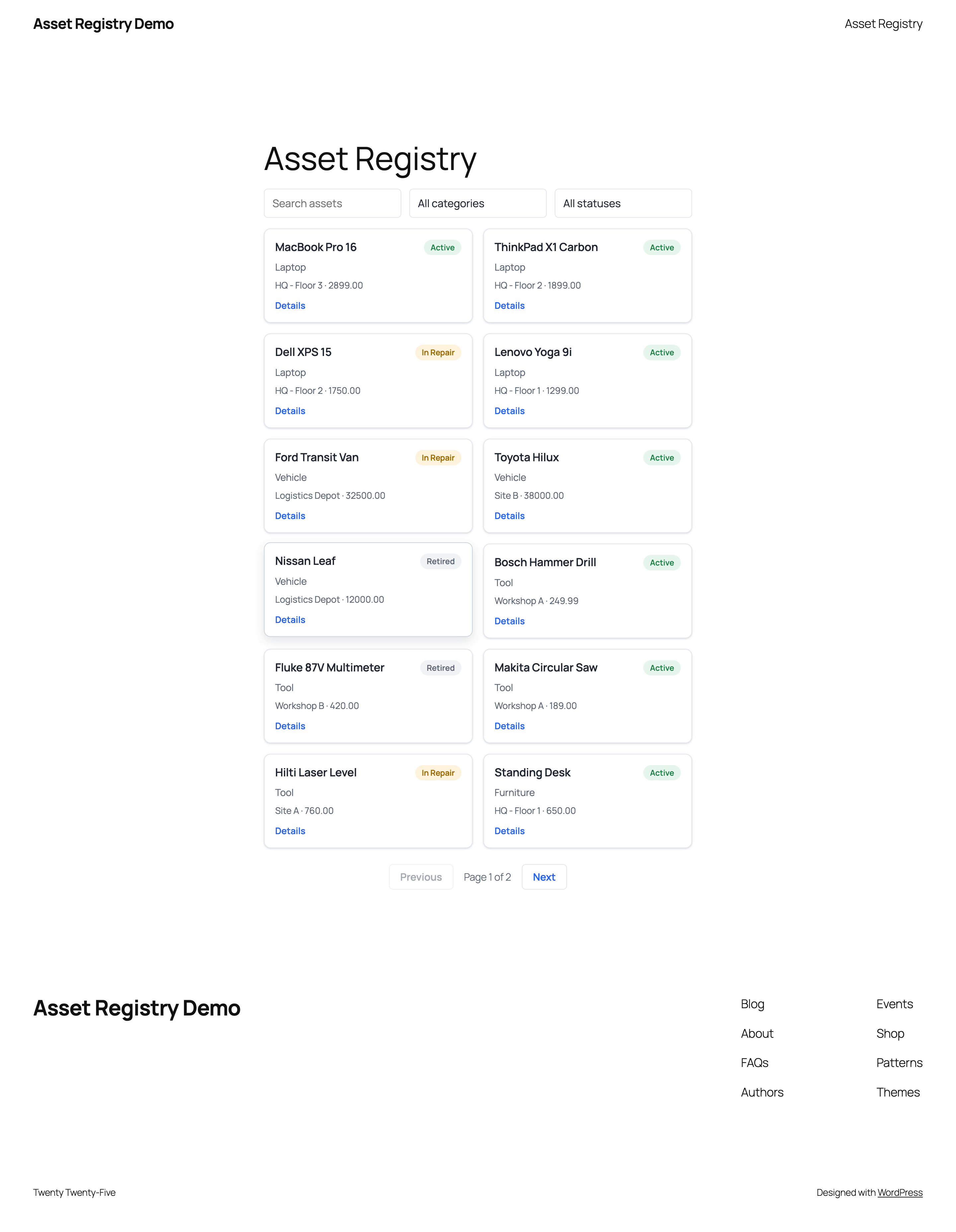
Front-end asset grid - responsive cards with category/status filters, search, and pagination.
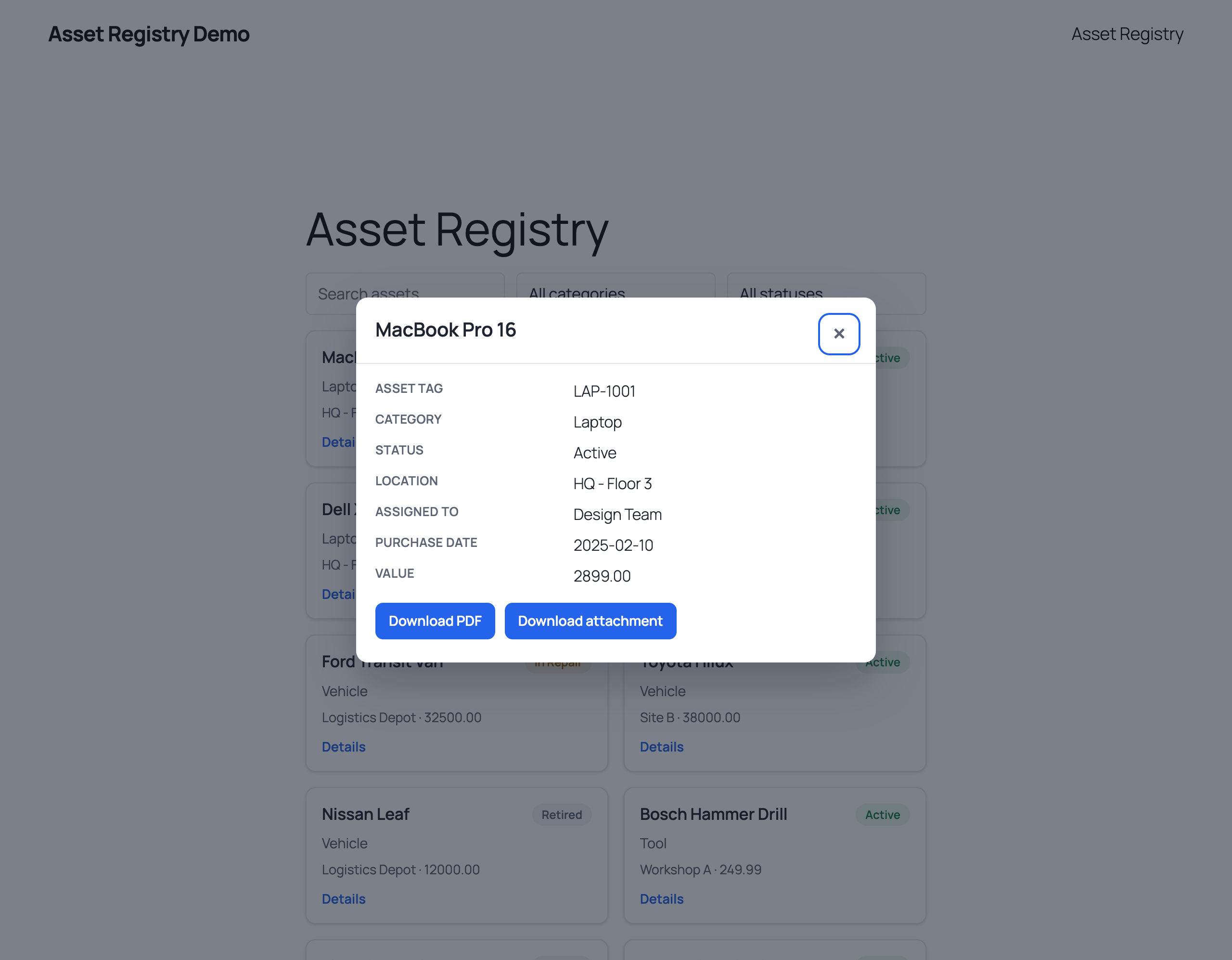
Asset detail - the detail dialog with gated PDF and attachment downloads for authorized viewers.
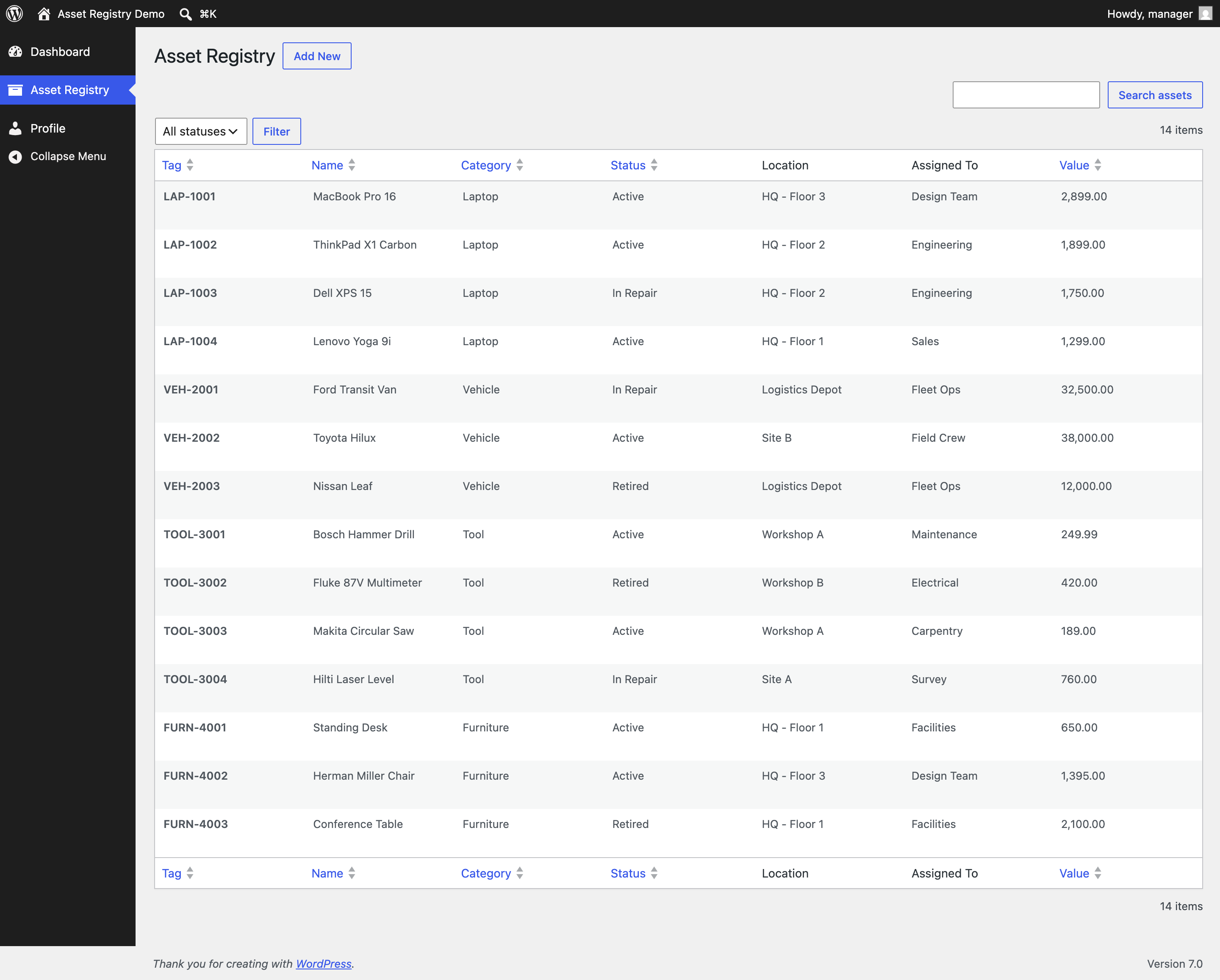
Admin list - the WP_List_Table with sortable columns, a status filter, search, pagination, and row actions.
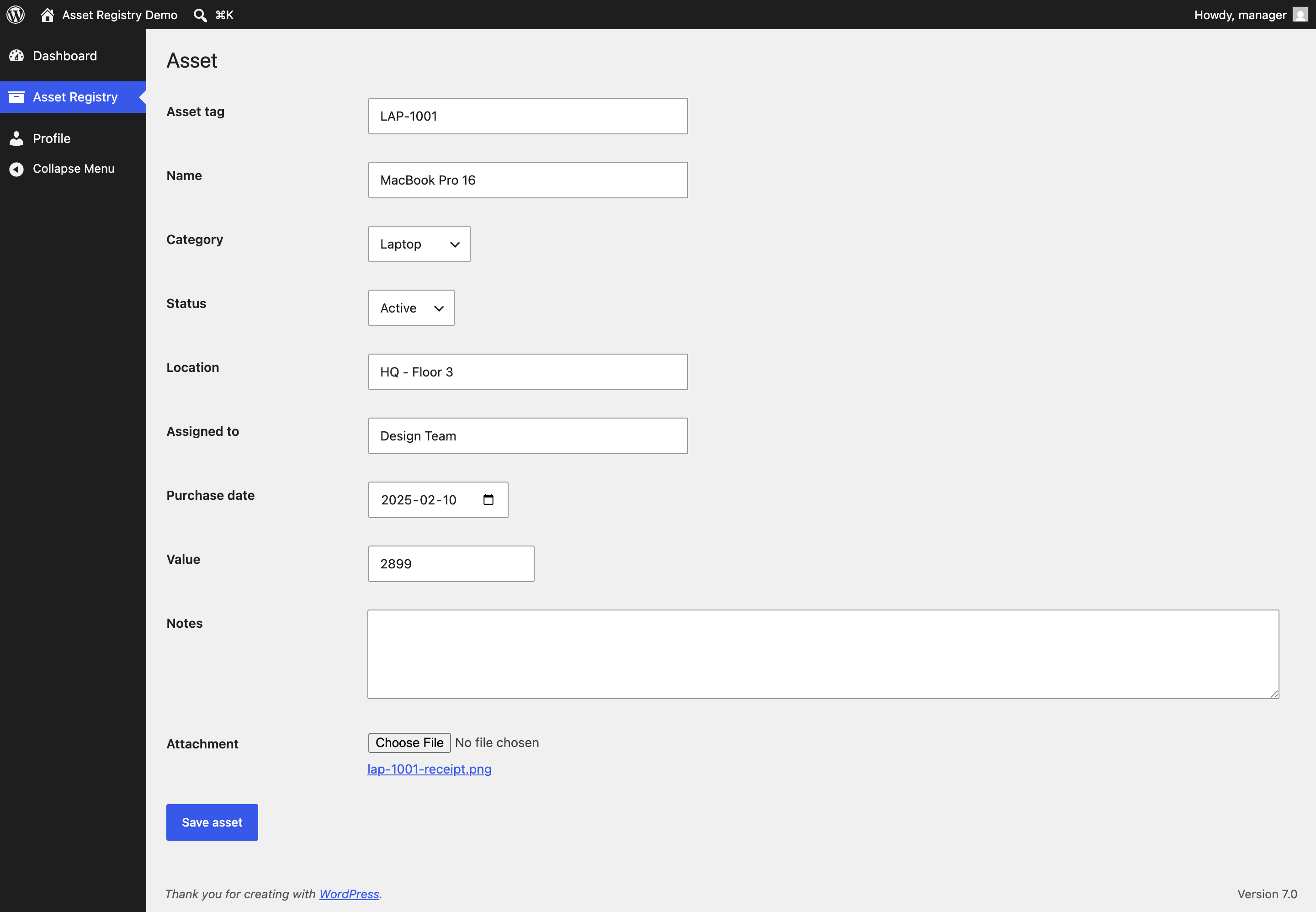
Admin add/edit form - validated, nonce-protected fields with attachment upload.
Features
Data and access control
- Custom
wp_ar_assetsdatabase table created on activation viadbDelta, modelling a single Asset entity. - Custom roles and capabilities: Registry Manager (
manage_assets) and Registry Viewer (view_assets). - Field-level visibility: a logged-out public preview exposes only name, category, and status; authorized viewers see every field.
Admin
- A
WP_List_Tableasset list with sortable columns, a status filter, full-text search, pagination, and row actions. - A validated, nonce-protected add/edit form with duplicate asset-tag detection and attachment upload.
- Delete with confirmation.
REST API and front end
- Custom REST namespace
asset-registry/v1withGET /assetsandGET /assets/{id}, pagination headers, and server-side field visibility applied per request. - An
[asset_registry]shortcode and a matching editor block. - A responsive, vanilla-JS card grid with category and status filters, debounced search, and an accessible asset detail dialog.
- Server-side PDF spec sheets rendered with Dompdf, served only behind a capability check and a per-asset nonce.
Secure files
- A traversal-safe protected attachment store served exclusively through an authenticated, capability-checked, nonce-guarded download route.
- The store is relocatable outside the web root via the
ASSET_REGISTRY_PROTECTED_DIRconstant or theasset_registry_protected_dirfilter, for servers that ignore.htaccess.
Engineering
- Composer with PSR-4 autoloading.
- PHPUnit and Brain Monkey unit-test suite (108 tests).
- WordPress Coding Standards (PHPCS) ruleset, clean.
- GitHub Actions CI matrix across PHP 8.1 through 8.4.
- Semantic Versioning and a Keep a Changelog history.
Architecture
The codebase follows a pure-logic-first design. The decision-making core is expressed as plain, side-effect-free PHP that can be unit-tested without a running WordPress: status and category enums, an asset DTO, the input sanitizer, the repository's SQL builders, the field-visibility resolver, the PDF HTML builder, and the traversal-safe path resolution are all pure functions. WordPress integration - hook registration, $wpdb queries, REST route registration, the WP_List_Table rendering, and file streaming - is kept as a thin shell that delegates to that core.
Key building blocks:
- Custom table. A single
wp_ar_assetstable holds the Asset records, created and versioned on activation. - REST namespace.
asset-registry/v1exposes read endpoints for the grid and detail view, applying field visibility on the server so the response never contains fields the requester is not entitled to see. - Capability model. Two capabilities,
manage_assetsandview_assets, gate every privileged action; the public preview is an explicit, narrow projection of the data rather than an unguarded query. - Secure files. Attachments live in a protected store that is never linked directly. Downloads pass through a gated route that checks login, capability, and a nonce before streaming the file, and the store can be moved outside the web root for servers that do not honor
.htaccessrules.
Requirements
- PHP 8.1 or later
- WordPress 6.4 or later
- Composer 2.x (to build from source)
Installation
From a release (end users)
- Download the latest
asset-registry-*.zipfrom the Releases page. - In the WordPress admin, go to Plugins -> Add New -> Upload Plugin, upload the ZIP, and activate it.
From source
git clone https://github.com/WaReZoR-UA/wp-asset-registry.git
cd wp-asset-registry
composer install --no-dev
Then copy the directory into wp-content/plugins/ (or symlink it) and activate the plugin from the WordPress admin.
Development
composer install      # install dependencies and register the coding standards
composer test         # run the PHPUnit unit suite
composer lint         # run WordPress Coding Standards (PHPCS)
composer lint:fix     # auto-fix fixable coding-standard issues
Work proceeds on feature branches; each change is reviewed via pull request before merging to main. CI runs the linter and the test matrix on every push and pull request.
Manual QA checklist
- [ ] Responsive layout verified at mobile, tablet, and desktop breakpoints.
- [ ] Role boundaries verified for administrator, Registry Manager, Registry Viewer, and logged-out visitor.
- [ ] Public-preview fields (name, category, status only) versus authenticated full-field visibility confirmed.
- [ ] Attachment download denied when logged out.
- [ ] PDF spec sheet denied when logged out.
- [ ] Direct access to a protected file (bypassing the gated route) denied.
- [ ] Activation, deactivation, and uninstall lifecycle leaves no orphaned table, roles, or options.
License
GPL-2.0-or-later.
Releases
5 releases. Each count is every asset in that release; expand a row for the breakdown.