Membership Health Check for Paid Memberships Pro
Read-only health checks for Paid Memberships Pro: finds members who still have access but stopped paying, subscriptions the gateway abandoned, dropped Stripe webhooks, and other quiet data drift. It reports; it never changes anything.
Install
This is the repository archive. It installs, but the folder name will carry the branch suffix and updates will not flow.
Install straight from GitHub with WP-CLI:
wp plugin install https://github.com/pobrien333/membership-health-check-for-paid-memberships-pro/archive/refs/heads/main.zip
Membership Health Check for Paid Memberships Pro
Finds members who still have access but stopped paying — plus the quieter data drift that accumulates in any long-running membership site.
Read-only. It reports; it never changes anything. Every finding needs a human decision, because a €0 order can be a deliberate comp or a payment you took by bank transfer, and only you know which.
Not affiliated with or endorsed by Stranger Studios, the makers of Paid Memberships Pro.
Why it exists
On the site this was written for, an afternoon of manual SQL turned up:
- a member on a 6-month plan whose last payment was September 2021 — four years of free access
- a subscription PMPro still listed as
activewhose next payment was due 983 days ago, quietly unbilled since 2023 - three former members still carrying their old membership role
- 69 active members missing the site's default role, invisible to every role-based query
- a 100%-off internal test code at 80 of its 100 uses, still valid
None of it was visible in the admin. Every one of those became a check.
The checks
| Check | Severity | What it means |
|---|---|---|
| Members with access but nothing billing | high | Subscription ended, membership never closed, no end date — indefinite free access |
| Members with access and no subscription behind it | info | Never had one at all — with the discount code that usually explains why |
| Payments not yet settled | info | Orders raised and never completed — PMPro rolls the subscription forward anyway, so they read as overdue nowhere |
| Subscriptions the gateway stopped charging | high | Still marked active, but the next payment date passed and no charge followed |
| Stripe webhook delivery | high | When each event type last arrived, whether billing has gone quiet, and what share of endings were lost |
| Level roles left on former members | medium | PMPro Roles missed the cleanup, usually via a bulk cancellation |
| Members without the default role | medium | PMPro Roles replaces it unless the level grants it too — silently breaks role queries |
| Memberships for deleted users | info | Orphaned rows that inflate every member count |
| Discount codes near their limit or expiry | info | A forgotten 100% code, or a test code about to break your checkout tests |
| Memberships ending in 30 days | info | Not a fault — the last window where a conversation still changes the outcome |
| Test accounts holding memberships | info | Test signups distorting your numbers |
The high checks are the ones that cost money.
What it looks like
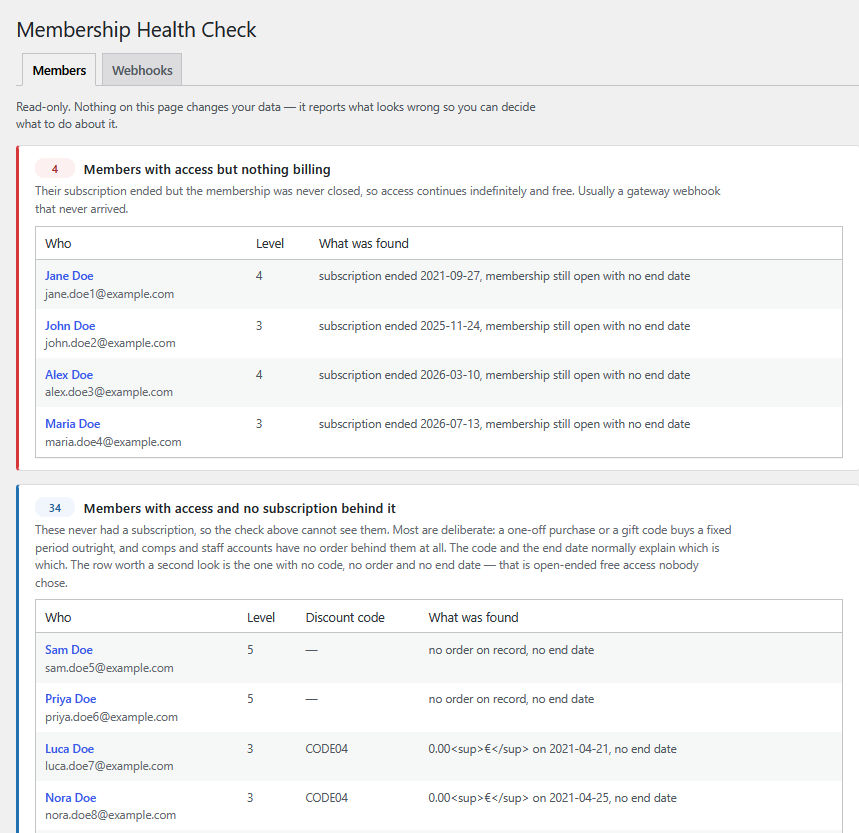
The Members tab. Every check is either clean or carrying a count, and each finding says what was found rather than only flagging a row.
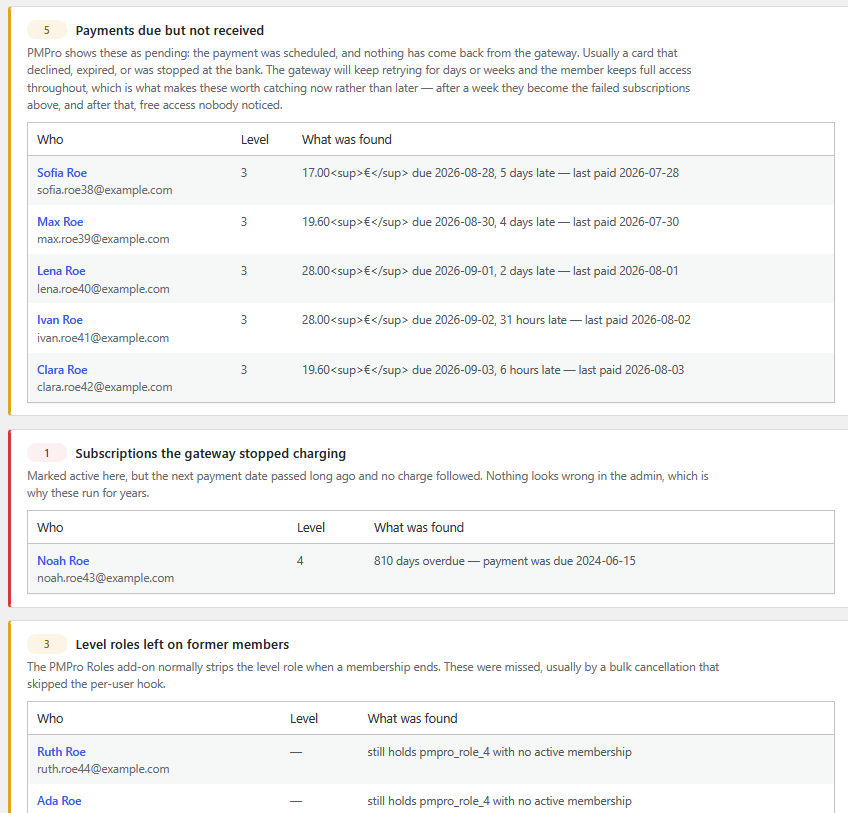
Further down: payments raised and never settled, a subscription the gateway stopped charging 810 days ago, and level roles left behind on people who are no longer members.
And the quieter end — orphaned rows, a discount code approaching its limit, and who lapses in the next thirty days.
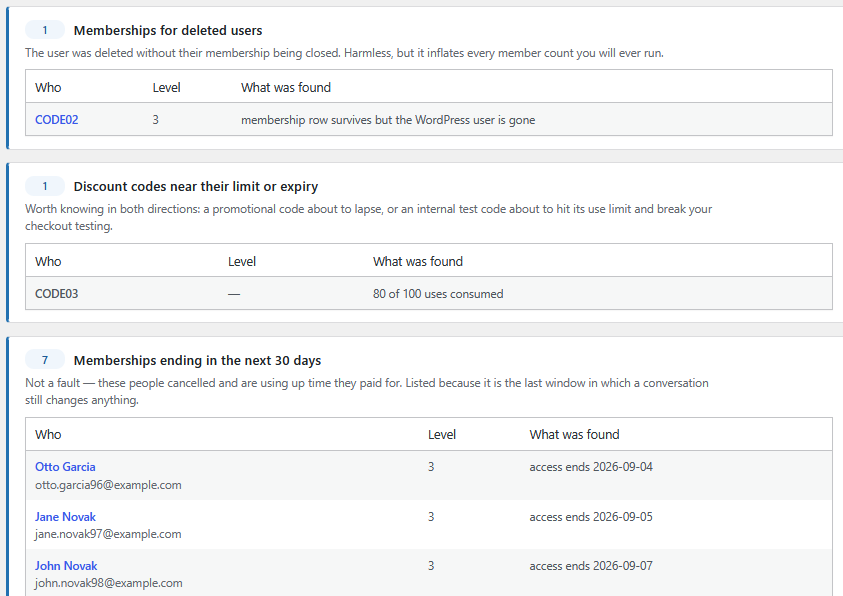
Names, addresses and discount codes are placeholders. The counts, dates and amounts are real.
The distinction that matters
A cancelled subscription with a future end date is a member winding down correctly — they paid through to a date and lapse on their own. A cancelled subscription without one is a leak.
That difference is the whole basis of the first check, and it's why "cancelled subscriptions" alone is a useless signal.
What the webhook check adds
PMPro already shows a Webhook History under Settings → Payment → Stripe, and the health check mirrors it so the whole picture stays on one screen. But that table cannot answer the question you actually have.
PMPro stores only the most recent timestamp per event type and overwrites it on every delivery.
That tells you the endpoint is alive. It cannot tell you whether every event arrived — and on the
site this was written for, three subscriptions leaked over twelve months while every event type
still read as recently received. customer.subscription.deleted, the event whose loss causes the
leak, showed as received five weeks after the most recent leak.
So the check adds two things PMPro's table structurally cannot give you:
- Silence, measured against the site's own billing rhythm rather than a fixed number of days. It takes the widest gap between order days over the past year and allows twice that, so a quiet site and a busy one both get a threshold that means something.
- Delivery loss, measured from the damage instead of from the gateway: of the subscriptions that ended in the past year, how many left a membership open with nothing billing. That shape only occurs when the event announcing the end never arrived, and it is the only evidence that survives once PMPro has overwritten its timestamp.
Neither needs a Stripe API call. The whole check is local option and table reads.
Usage
Memberships → Health Check, which has two tabs:
- Members — the ten checks about people.
- Webhooks — the gateway link, including PMPro's per-event last-received times.
Only the open tab runs its queries, so each view costs about what one check costs.
Or over SSH, where every check runs at once:
wp membership-health                      # readable summary
wp membership-health --format=csv         # every finding, flat
wp membership-health --format=json        # same, as JSON
wp membership-health --format=count       # bare number, for monitoring
wp membership-health --check=webhook_health
--format=count exits with a plain number, so it drops into a cron one-liner that emails you only
when it's non-zero.
Cost
Nothing runs in the background. No cron, no front-end code, no options written. The checks execute only when you open the page or run the command, so a busy site pays nothing for having this installed.
On a site with ~900 users and ~2,700 orders the full run takes well under a second.
Requirements
- WordPress 6.0+, PHP 7.4+
- Paid Memberships Pro
- PMPro Roles add-on (optional — the two role checks skip themselves without it)
Customising
Test-account detection works in two layers.
Two rules are built in and anchored, so they cannot catch a real address:
- Addresses ending in a domain reserved by RFC 2606 or RFC 6761 —
@example.com,.invalid,.localhost,.test. Those can never be delivered to on any network. Anchoring means a real domain that merely contains the word (testkitchen.com,example-design.com) is left alone. - A mailbox starting
test@. Anchored to the front, solatest@andgreatest@are not swept up with it.
Everything else is a convention, and conventions are local. The defaults are +test and +demo;
add your own. Values are matched literally wherever they appear in the address — punctuation is
escaped for you, so +test (old) means those characters and not a pattern:
add_filter( 'mhcheck_test_email_patterns', function ( $patterns ) {
    $patterns[] = '+staging';
    $patterns[] = '+internal';
    return $patterns;
} );
Deliberately short by default: a wrong guess here quietly accuses a paying member of being fake.
When an unsettled payment shows up
An order counts as unsettled an hour after it was raised — long enough to exclude payments that are genuinely still in flight, short enough that this morning's still appears. Bank debits legitimately sit for days, so sites taking those will want longer:
add_filter( 'mhcheck_pending_payment_grace_hours', function () {
    return 72;
} );
This is reported as information rather than a fault. Most resolve on their own: the gateway either takes the money or gives up, and giving up normally closes the membership without anyone intervening. The value is having somewhere to see them at all.
Running it on a copy
Every date-based check compares a stored date against the current clock. On a staging site restored from a backup those disagree by the age of the copy, so payments taken since the snapshot look missing, cancellations look ignored, and members who have left look like leaks. The findings are accurate about the database in front of them and worthless about your business.
The report says so when WP_ENVIRONMENT_TYPE is anything other than production. Not every host
sets it, so the webhook check also names a restored copy as one explanation when billing has gone
quiet. If a report looks alarming, check which database you are pointed at before you act on it.
Development
composer install
composer lint
PHPCS runs the WordPress standard plus a PHP 7.4 compatibility gate matching the plugin header. The tree is clean — no errors, no warnings, and no baseline.
Building a release
composer buildStages a clean copy into dist/, honouring .distignore, and zips it if PHP has the zip
extension. Point WordPress's Plugin Check at dist/<slug>/ rather than the working folder,
or it will report the development files as violations.
On Windows, where PHP often lacks the zip extension, follow it with:
composer zipDo not zip the folder with Compress-Archive. Windows PowerShell writes ZIP entry names
with backslashes, which the specification forbids; WordPress then fails to find a plugin folder
inside the archive, wraps it in a directory named after the zip file, and installs it as a
separate plugin one level too deep. bin/zip.ps1 writes the entry names itself and refuses to
finish if any backslash or more than one top-level entry survives.
The archive is deliberately named membership-health-check-for-paid-memberships-pro.zip, with
no version. WordPress identifies a plugin by its folder, and names that folder after the zip
whenever it cannot find one inside — so a version in the filename becomes a version in the
installed folder, and every release then installs as a new plugin instead of upgrading. The
version belongs in the plugin header and the changelog, not in a path.
Changelog
Summarised here; the reasoning behind each change is in CHANGELOG.md.
- 0.5.1 — The version now shows beside the report heading and in the WP-CLI output. Fixed
amounts printing their markup: PMPro returns HTML for some currency positions, so a euro after
the amount rendered as
17.00<sup>€</sup>. - 0.5.0 — Eleventh check: payments not yet settled. Orders raised and never completed, on members who still have access. PMPro advances the subscription on the strength of an unsettled order, so the membership reads as paid and these appear nowhere else. Reported as information, since most resolve on their own.
- 0.4.0 — Tenth check: members holding access with no subscription behind them, shown with the discount code that usually explains it. Checks can now contribute their own findings columns.
- 0.3.1 — Text domain matched to the plugin slug, so translations load. Queries rewritten so
WordPress's Plugin Check can verify them, and a real false positive fixed:
test@had been matching as a substring, flagging addresses likelatest@example.org. - 0.3.0 — Split into two tabs, Members and Webhooks, with only the open tab querying.
Test-account matching generalised to RFC-reserved domains. PHPCS added and the tree cleaned.
Breaking: prefix is now
MHCHECK_, and the filter ismhcheck_test_email_patterns. - 0.2.0 — Ninth check: Stripe webhook delivery, measured against the site's own billing rhythm and its own delivery loss rather than trusted.
- 0.1.0 — First release. Eight read-only checks.
License
GPL-2.0-or-later. See LICENSE.