MBR Cookie Consent WP Registry grade A. No security issues foundWP RegistryNo security issues foundOpen the reportA
Enterprise-grade GDPR/CCPA compliant cookie consent w Google Consent Mode v2, 20+ languages, WCAG accessibility, and privacy policy generator.
Install
Upload it under Plugins → Add New Plugin → Upload Plugin, then activate.
Install straight from GitHub with WP-CLI:
wp plugin install https://github.com/harbourbob/mbr-cookie-consent/releases/download/v-2.6.0/mbr-cookie-consent-v2.6.0.zip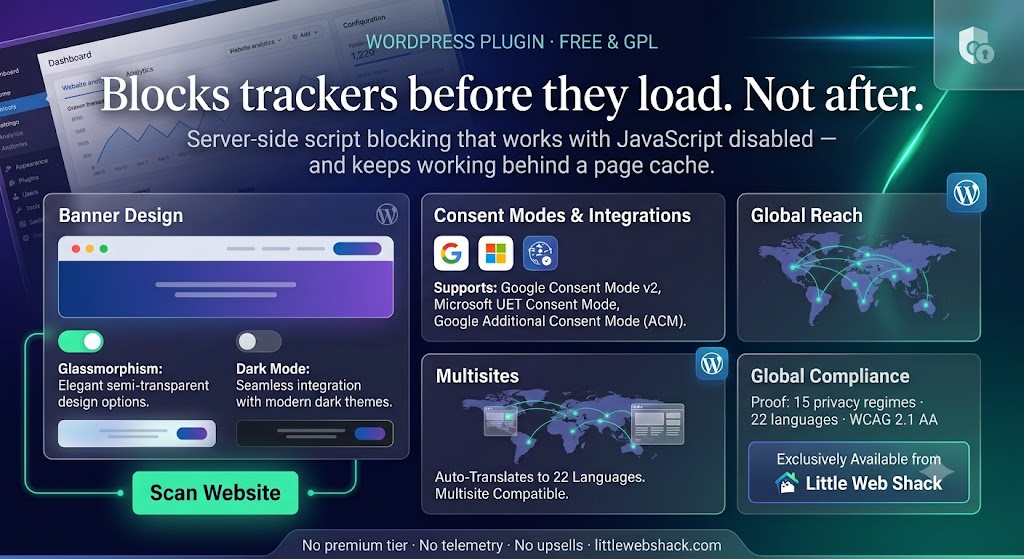
MBR Cookie Consent
Enterprise-grade privacy compliance for WordPress. Genuinely free, forever.
GDPR · UK DUAA · CCPA · 24 US state laws · LGPD · PIPEDA · Quebec Law 25 · Swiss nFADP
Australia Privacy Act · India DPDP · Vietnam PDPL · Indonesia UU PDP · Nigeria NDPA
China PIPL · South Korea PIPA · Saudi PDPL · South Africa POPIA · Global Privacy Control
No premium tier. No upsells. No telemetry. No vendor lock-in. No third-party logo on your banner.
Download · Releases · Report an issue
Why this exists
Privacy compliance became something small businesses were expected to pay £99–£299 a year for — often in exchange for a banner carrying somebody else's logo.
This plugin takes the opposite view. Every feature you would expect from an enterprise consent platform is in the free version, fully documented, and yours to configure. No feature is held back behind a paywall, because there is no paywall.
It is built the way I build everything: pure PHP, no Composer, no external dependencies, no CDN calls, no telemetry, and updates served straight from the developer.
What you get
| Real script blocking | Non-essential scripts and embeds are held at the server via output buffering and never execute until consent is given. Not a banner that hides and hopes. |
| Safe behind a page cache | Every visitor is served an identical, fully-blocked page and their own choice is applied in the browser — so a cache can never serve one visitor's consent to another. (v2.3.3) |
| Server-side form gating | Form submissions are blocked on the server until consent is granted — cannot be bypassed by disabling JavaScript. |
| Automatic regional compliance | Sixteen detected privacy regions, each with the correct consent model applied automatically. |
| Consent Mode v2 | Google Consent Mode v2, Microsoft UET Consent Mode and Google Additional Consent, signalled the way the specification intends — denied default, then an update carrying the visitor's choice. |
| Global Privacy Control | The GPC browser signal detected per visitor and honoured automatically, without banner interaction. |
| AI / LLM training disclosure | Connecticut SB 1295 requires your privacy notice to state whether personal data trains large language models. Built in. (v2.3.0) |
| Settings portability | Export a tuned configuration to JSON and import it on any number of other sites. (v2.2.0) |
| Audit-ready logging | Every consent interaction recorded with anonymised IP, exportable to CSV. |
| 22 languages | Community translations selected by browser language, each requiring your approval before it is shown. Full WPML and Polylang string registration alongside. (working from v2.3.3) |
| WCAG 2.1 AA | Keyboard navigation, screen reader support, focus traps, ARIA labels, reduced-motion support. |
Free vs. the alternatives
| MBR Cookie Consent | Typical premium plugins | |
|---|---|---|
| Price | Free forever | £99–£299/year |
| Google Consent Mode v2 | Included | Premium only |
| Global Privacy Control | Included | Premium only |
| UK DUAA 2025 compliance | Included | Premium only |
| US multi-state coverage | Included | Premium only |
| AI / LLM training disclosure | Included | Rarely offered at all |
| 22 community translations | Included | Premium only |
| Correct behind a page cache | Yes | Frequently not |
| Server-side form gating | Included | Rarely offered at all |
| Settings import / export | Included | Premium only |
| A/B testing | Included | Premium only |
| Geolocation detection | Included | Premium only |
| Multisite support | Included | Premium only |
| Telemetry / phone-home | None | Common |
| Vendor lock-in | None | Proprietary |
Global privacy coverage
Visitor location is detected automatically and the correct consent model applied — one configuration, every jurisdiction.
| Region | Law | Consent model | Since |
|---|---|---|---|
| EU / EEA | GDPR + ePrivacy | Strict opt-in for all non-essential cookies | v1.6.0 |
| United Kingdom | UK GDPR + DUAA 2025 | Analytics & functionality exempt (opt-out); advertising requires consent | v2.0.0 |
| Switzerland | nFADP | Transparency-led, opt-out | v2.1.0 |
| United States | CCPA/CPRA + state laws | Opt-out, with GPC honoured | v2.0.0 |
| Quebec | Law 25 | Express opt-in | v2.1.0 |
| Canada (rest) | PIPEDA / CASL | Meaningful consent | v1.6.0 |
| Brazil | LGPD | Opt-in, GDPR-style | v1.6.0 |
| Australia | Privacy Act | Notice and reasonable expectation | v2.1.0 |
| India | DPDP Act 2023 | Granular opt-in, one-click withdrawal | v2.0.0 |
| Vietnam | PDPL 91/2025/QH15 | Opt-in, granular per-purpose consent | v2.1.1 |
| Indonesia | UU PDP No. 27/2022 | Opt-in, purpose-specific with easy withdrawal | v2.1.2 |
| Nigeria | NDPA 2023 + GAID 2025 | Opt-in, prominent homepage notice mandated | v2.3.0 |
| China | PIPL | Explicit opt-in, granular per-purpose | v2.3.0 |
| South Korea | PIPA | Specific, informed, prior consent | v2.3.0 |
| Saudi Arabia | PDPL | Opt-in, Arabic banner heading by default | v2.3.0 |
| South Africa | POPIA | Opt-in for electronic direct marketing (s.69) | v2.3.0 |
| Rest of world | Best practice | Opt-in by default; configurable | v1.6.0 |
US state laws: 24 states have now enacted comprehensive privacy laws, 20 of them currently in effect. All follow the Virginia opt-out model, so no banner behaviour changes as more come into force.
China PIPL — documented limitation: PIPL requires separate standalone consent for cross-border transfers, plus a transfer mechanism (CAC assessment, standard contract, or certification). This plugin does not provide either. If you serve mainland China, handle that separately.
New in 2.3
Five new privacy regions (v2.3.0)
Nigeria (NDPA + GAID), China (PIPL), South Korea (PIPA), Saudi Arabia (PDPL) and South Africa (POPIA) are now detected separately, each with its own consent model, compliance card and — where appropriate — a localised banner heading.
Nigeria's GAID is worth singling out: effective 19 September 2025, it is one of the few instruments anywhere that prescribes banner placement. A prominent homepage notice is required — a footer link is not sufficient — with a genuine accept/decline choice, no pre-ticked boxes, and no implied consent from continued browsing.
AI / LLM training disclosure (v2.3.0)
Connecticut SB 1295, effective 1 July 2026, is the first US state law requiring your privacy notice to state whether you collect, use, or sell personal data to train large language models. A new section under Advanced Consent controls this, and the privacy policy generator produces matching text — including a clear "we do not" statement when none of the options apply, which is the correct answer for most sites.
"Rest of World" now defaults to opt-in (v2.3.0)
The fallback region previously shipped with implied consent and auto-accept-on-scroll, which was wrong for the several genuine opt-in jurisdictions that fall through to it.
Existing sites are not changed. An upgrade routine writes your previous values as explicit settings, so only new installations get the stricter posture. You can change it either way under Geolocation.
Consent that survives a page cache (v2.3.3)
The largest correctness change the plugin has had, and the reason to update.
Everything that mattered — what to block, what to tell Google, whether the visitor had sent a GPC signal — was decided on the server by reading the visitor's own request. A page cache stores one copy of a page and serves it to everybody, so whichever visitor happened to generate that copy had their consent baked into it.
In practice: the first visitor to accept everything caused a fully unblocked page to be stored, and every visitor served that copy afterwards got the trackers running whatever they themselves had chosen. Google and Microsoft were told those visitors had consented. And a single visitor with Global Privacy Control enabled could cause everyone after them to be treated as having opted out.
None of it was visible from the admin screens. The settings were right, the banner appeared, and the blocking was not happening.
Every visitor is now served an identical page with everything held, and their own choice is applied in their browser. Blocking, Consent Mode signalling, GPC and language selection all moved client-side. The page is the same whoever generates it, which is precisely what makes it safe to cache — and faster, since the rewriting work happens once per cache miss rather than once per visitor.
Video facades are blocked (v2.3.3)
Performance plugins commonly replace a video embed with a click-to-play facade: a poster image and a placeholder holding the video address, with the real player built in JavaScript on click. No embed remained in the page for the consent layer to find, so the video loaded regardless of consent while the site owner had every reason to believe it was blocked.
Facades are now recognised and held by their data attribute, and released by the browser on consent. The technique is matched rather than any one product, so MBR Performance, SG Optimizer, WP Rocket and others are all covered. Poster images are held too — a facade avoids the provider's cookies but still fetched its thumbnail, sending the visitor's IP to YouTube or Vimeo on page load.
If you run a video lazy-load or facade option, test an embed after updating. Reject cookies and confirm the placeholder appears in place of the video. This was a silent failure, so it is worth seeing it work.
Automatic translation actually works (v2.3.3)
Earlier versions advertised auto-translation in "40+ languages". There were 22, they covered about half the strings the banner displays, and none of them ever reached a visitor — the translation code was attached to a filter the plugin never called. The setting had no effect whichever way it was set.
All 22 are now complete across every string, and the feature works. Because these are consent notices rather than ordinary interface text, and the translations are community-contributed rather than professionally produced, nothing is served until an administrator has read that language and approved it on the new Translations screen. An unapproved language falls back to your own wording.
Corrections and new languages are welcome — the catalogues are plain JSON, one file per language, in languages/banner/.
IAB TCF removed (v2.3.3)
The feature never worked. It sent every vendor the same fixed consent string regardless of what the visitor had chosen, reported a CMP ID of zero, and returned an empty vendor list — so no vendor could act on it correctly, and a fixed signal claiming consent is worse than sending none at all.
Supporting TCF properly requires registration as a Consent Management Platform with IAB Europe, which this plugin does not have and is not in a position to obtain. The option, its settings and its scripts have been removed, and sites that had it enabled get a one-time notice.
If you generated a privacy policy while TCF was enabled, regenerate it. It stated that your site participates in the Transparency and Consent Framework, which was not accurate.
Appearance and workflow (v2.3.2)
Glassmorphism with opacity and blur controls and a live WCAG contrast readout, a dark mode that can follow the visitor's system setting, a Media Library logo picker, and a Preview button that renders the banner with your unsaved changes.
Also a correction worth knowing about: banner text set in the plugin was being ignored on the front end when WPML was active. The setting saved, the admin field showed the new wording, and the front end silently kept the old. In your site's default language the plugin's own setting is now authoritative.
Security release (v2.3.1)
Version 2.3.1 is the outcome of a full security audit of the plugin's own source code. Eleven security findings and seven reliability findings were identified and fixed. No exploitation was reported — everything was found by review.
The headline items:
- Forwarding headers are no longer trusted blindly.
X-Forwarded-For,X-Real-IPandCF-Connecting-IPcan be set by any visitor. Trusting them meant a visitor could nominate their own IP — and therefore their own privacy regime — and could mint unlimited distinct "IPs", each creating a cache entry and an outbound lookup. A new Visitor IP Detection setting controls this. The default validates Cloudflare's header against Cloudflare's own published ranges, so Cloudflare sites keep working with no configuration. - Geolocation lookups no longer run over plain HTTP. ip-api.com serves HTTPS only on its paid tier. Over plain HTTP the country returned can be rewritten in transit, silently changing which privacy regime a visitor receives, and visitor IPs travel to a third party unencrypted. Sites using it without a key are migrated to ipapi.co (free, HTTPS) with a dismissible notice explaining why.
- The consent log is throttled. The logging endpoint has to accept unauthenticated requests, because a nonce baked into cached HTML goes stale. It now rate-limits per visitor, so the record you would rely on to demonstrate compliance cannot be flooded with junk.
- Blocked scripts now restore reliably. A missing variable binding left
src-blocked scripts without a category label, so after a visitor accepted cookies those scripts could silently fail to start. If you use script blocking, this is the fix that matters most. - Subdomain consent sharing works on
.co.uk. The root domain was calculated as the last two labels, soshop.example.co.ukproduced a cookie scoped toco.uk— which every browser rejects. Affected all of.co.uk,.com.au,.co.nzand similar.
Full detail in the changelog and the security audit report.
If you use A/B testing, reset your statistics after updating. Impressions were counted on every page load rather than once per visitor, so existing figures are inflated — and not evenly across variants. Any promote-winner decision made on the old data is unsound.
Security
The plugin's source code was audited in full at version 2.3.0 and every finding was remediated in 2.3.1. A second review at 2.3.2 raised eighteen further findings — correctness and architecture rather than exploitable vulnerabilities — and all eighteen were fixed in 2.3.3, along with two problems that review had not found.
Read the security audit report (PDF)
The audit was carried out by Claude (claude.ai), an AI assistant made by Anthropic, at my request. It was a static source code review — not a penetration test, not an accredited third-party audit, and it carries no warranty or certification. The report states its own limitations plainly, and I would rather publish it with those caveats attached than not publish it at all.
What it found clean is worth stating: no SQL injection, no cross-site scripting, no missing permission or nonce checks across the plugin's twenty administrative actions, and none of the PHP functions commonly associated with serious vulnerabilities. What it found wrong clustered in one place — the endpoints that must accept requests from ordinary visitors rather than logged-in administrators, which is genuinely awkward territory for a consent plugin when page caching makes nonces unreliable.
The 2.3.3 round is worth summarising honestly, because several findings were features that did not work rather than code that was unsafe: consent state leaking between visitors through a page cache, an inline-blocking pattern that could delete page content, a page-exclusion setting that caused a fatal error on every front-end request once used, consent log rows that all recorded the same method, and an unescaped CSV export that let an unauthenticated visitor plant a spreadsheet formula. Two more were found by testing on a live site rather than by review: video facades defeating script blocking entirely, and the GPC caching fault described above.
Found something? Email rob@littlewebshack.com rather than opening a public issue, and I will credit you here unless you would rather I did not.
Install
From Little Web Shack (recommended — includes automatic updates)
- Download from littlewebshack.com
- Upload via Plugins → Add New → Upload Plugin, then Activate
- Enable geolocation by adding this to
wp-config.php:define('MBR_CC_FORCE_GEOLOCATION', true); - Configure at Cookie Consent → Dashboard
From GitHub — grab the ZIP from Releases, upload to /wp-content/plugins/mbr-cookie-consent/, activate, and add the constant above.
Quick start
| Step | Where | What to do |
|---|---|---|
| 1. Scan | Cookie Consent → Cookie Scanner | Start Scan, review detected scripts, add non-essential ones to the blocked list |
| 2. Categorise | Cookie Consent → Categories | Match category names and descriptions to your privacy policy |
| 3. Style | Cookie Consent → Settings | Position, colours, text, and optional features |
| 4. Generate policy | Cookie Consent → Dashboard | Generate Cookie Policy Page, review, publish |
| 5. Test | Incognito window | Verify Accept / Reject / Customise all behave, and scripts block correctly |
To test GPC, use Firefox or Brave with the signal enabled and confirm the "Opt-Out Request Honored" toast appears.
Behind Cloudflare or a reverse proxy? Check Settings → Geolocation → Visitor IP Detection. The default handles Cloudflare automatically. For any other proxy or load balancer, switch to reverse-proxy mode and list your proxy addresses, or geolocation will see the proxy rather than the visitor.
Full feature list
Consent management
- Customisable banner — Accept All, Reject All, Customise
- Automatic script blocking — non-essential scripts held until explicit consent
- Preference centre — granular category-by-category control
- Revisit consent button — floating button so visitors can change their mind any time
- CCPA "Do Not Sell or Share" — required opt-out link for US visitors
- Global Privacy Control — automatic detection and honouring of the GPC signal (v2.0.0)
- Click-to-play facade blocking — video facades built by performance plugins are held too, along with their poster images (v2.3.3)
- Consent logging — every interaction recorded, exportable to CSV
- GDPR-compliant storage — IP anonymisation and proper data handling
- Geolocation detection — auto-detects country and applies the right regime (v1.6.0)
- Spoof-resistant IP detection — proxy headers honoured only from verified proxies (v2.3.1)
- Multisite support — network-aware, adjusts settings across sites (v1.5.0)
- Settings import / export — portable JSON configuration with one-step revert (v2.2.0)
Consent Mode integration
- Google Consent Mode v2 —
ad_storage,ad_user_data,ad_personalization,analytics_storage,functionality_storage,personalization_storage - Microsoft UET Consent Mode — EU consent requirements for Microsoft Advertising
- Configurable default states (denied recommended for EU/EEA)
- Ads data redaction and optional URL passthrough
Global Privacy Control (v2.0.0)
When a browser sends Sec-GPC: 1 (Firefox, Brave, DuckDuckGo, Privacy Badger), the plugin:
- Detects the signal in the visitor's own browser via
navigator.globalPrivacyControl - Suppresses marketing cookies without requiring banner interaction
- Shows the California-mandated "Opt-Out Request Honored" confirmation toast
- Logs GPC status alongside the consent record
Changed in 2.3.3. Earlier versions also read the
Sec-GPCrequest header on the server and wrote the result into the page. On a cached site that meant one visitor with GPC enabled could prime the cache with it, after which every visitor was treated as having opted out — suppressing marketing consent site-wide, silently. Detection is now per-visitor in the browser, which is where the GPC specification puts it. A "server-side backstop" was also documented in earlier releases; it never functioned, and could not have done behind a cache.
Enabled by default. To also suppress analytics, enable mbr_cc_gpc_suppress_analytics, or filter the categories via mbr_cc_gpc_suppressed_categories.
AI / LLM training disclosure (v2.3.0)
Connecticut SB 1295 (effective 1 July 2026) requires privacy notices to state whether personal data is used to train large language models. Under Advanced Consent you can declare whether you:
- train your own models on personal data
- share personal data with AI vendors for training
- sell personal data for AI training
The privacy policy generator writes matching text, including an explicit "we do not" statement when none apply — which is the right answer for most sites, and worth saying out loud rather than staying silent.
Banner customisation
- Layouts — bar (full width), box (bottom left/right), popup (centre)
- Colours — primary, accept, reject, and text colours
- Custom text — heading, description, and every button label
- Logo — chosen from the Media Library, on the banner and preference centre (v2.3.2)
- Glassmorphism and dark mode — with a live WCAG contrast readout as you adjust (v2.3.2)
- Preview — render the banner with unsaved changes before committing (v2.3.2)
- Reload on consent — optional page reload after a consent action
Cookie scanner and management
- One-click scanner — detects scripts and iframes across your site
- Manual management — add, edit, or remove blocked scripts at any time
- Category management — Necessary, Analytics, Marketing, Preferences
Form builder integration (v1.9.0)
Blocks form submissions server-side until consent is granted — cannot be bypassed by disabling JavaScript.

- Supported — Contact Form 7, WPForms, Gravity Forms, Elementor Forms
- Elementor modal — clean dark overlay replaces inline errors, with Accept Cookies and Not Now
- Auto re-submit — after accepting, the pending submission replays automatically with all data intact
- Configurable — choose the required category and customise the blocked message
A/B testing (v1.9.0)
- Three variants — bottom bar (A), popup (B), box-left (C)
- Session persistence — the same visitor always sees the same variant
- Conversion tracking — impressions and accept-all rate per variant, deduplicated per visitor (v2.3.1)
- Results dashboard — live table, bar charts, winner indicator
- Promote winner — one click sets the winning variant live
Internationalisation and accessibility
- 22 community translations — selected by browser language, applied in the browser so pages stay cacheable (working from v2.3.3)
- Approval required — no translation is shown to a visitor until an administrator has read and approved that language
- Your wording is never overwritten — strings you have customised are left as you wrote them
- WPML and Polylang — full string registration and translation support
- WCAG 2.1 AA — keyboard navigation, screen readers, focus traps, ARIA labels, high contrast, reduced motion
Legal policy tools
- Privacy Policy Generator — builds a policy page from your actual site configuration, including AI training disclosure
- Cookie Policy Generator — creates a cookie policy page template
- Legal disclaimers — built in throughout the admin interface
Compliance summary by region
EU / EEA — GDPR + ePrivacy
Explicit opt-in for all non-essential cookies · clear information about usage · easy revocation · IP anonymisation · full audit log · granular category control · policy generators. EEA non-EU members (Iceland, Liechtenstein, Norway) included since v2.1.0.
United Kingdom — UK GDPR + DUAA 2025
Analytics, functionality, security and software-update cookies exempt from consent under DUAA Schedule A1 · transparency and easy opt-out still required · advertising still requires explicit consent · PECR fines up to £17.5M or 4% of global turnover · formal complaints procedure in force since 19 June 2026.
United States — CCPA/CPRA + state laws
"Do Not Sell or Share My Personal Information" link · GPC honoured automatically · California-required "Opt-Out Request Honored" confirmation · opt-out model · clear disclosure. 24 states enacted, 20 in effect; all follow the Virginia opt-out model. Connecticut SB 1295 adds AI training disclosure from 1 July 2026, with SB 4 following on 1 October 2026.
Switzerland — nFADP (v2.1.0)
Transparency-led with opt-out, distinct from GDPR.
Quebec — Law 25 (v2.1.0)
Express opt-in, detected separately from the rest of Canada.
Canada — PIPEDA / CASL
Meaningful consent with purpose disclosure · CASL classifies cookies as computer programs requiring consent.
Australia — Privacy Act (v2.1.0)
Notice-based with reasonable-expectation standard.
Brazil — LGPD
Opt-in consent with Portuguese defaults · revocation · data minimisation.
India — DPDP Act 2023
Granular consent with one-click withdrawal · standalone privacy notice · verifiable parental consent for minors · Consent Manager registration opens November 2026 · full compliance mandatory by May 2027.
Vietnam — PDPL (v2.1.1)
Law 91/2025/QH15, in force 1 January 2026. Consent-centric: silence is not consent, bundled consent prohibited, withdrawal must be easy. Vietnamese-language banner heading by default.
Indonesia — UU PDP (v2.1.2)
Law No. 27 of 2022, fully effective since 17 October 2024 and upheld by the Constitutional Court in January 2026. GDPR-style and extraterritorial, with purpose-specific consent and an Indonesian-language heading by default.
Nigeria — NDPA + GAID (v2.3.0)
Nigeria Data Protection Act 2023, with the NDPC's General Application and Implementation Directive effective 19 September 2025. Unusually prescriptive about placement: a prominent homepage notice is required, a footer link is not sufficient, and a genuine accept/decline choice must be offered. No pre-ticked boxes and no implied consent from browsing. Only strictly necessary cookies are exempt. Extraterritorial.
China — PIPL (v2.3.0)
Explicit, voluntary, fully informed opt-in before non-essential cookies. Cookie identifiers that single out a visitor count as personal information. Extraterritorial. Documented limitation: PIPL's separate standalone consent for cross-border transfers, and the transfer mechanism itself (CAC assessment, standard contract or certification), are not provided by this plugin and must be handled separately.
South Korea — PIPA (v2.3.0)
Specific, informed, prior consent wherever cookie data can identify a person — notice-then-opt-out is not sufficient in that case. PIPC guidance updated April 2025 requires concrete instructions on blocking or refusing cookies. Behavioural advertising is a stated supervision priority, and documentation expectations are high.
Saudi Arabia — PDPL (v2.3.0)
Consent is the default lawful basis. Enforceable since September 2023 with the grace period ended September 2024; SDAIA enforcement active since 2025. Arabic banner heading by default.
South Africa — POPIA (v2.3.0)
Section 69 requires opt-in for electronic direct marketing, which is the operative provision for most cookie use.
For developers
Check consent programmatically
// Has the visitor consented to analytics?
window.MbrCcConsent.hasCategoryConsent('analytics', function (allowed) {
    if (allowed) {
        // Load your analytics script
    }
});
Detect the GPC signal
// Server-side
if (function_exists('mbr_cc_gpc') && mbr_cc_gpc()->is_gpc_active()) {
    // Visitor has opted out via Global Privacy Control
}
// Client-side (also exposed via the mbrCcGpc localised object)
if (navigator.globalPrivacyControl === true) { /* GPC is active */ }Resolve the visitor's IP (v2.3.1)
// Respects the configured proxy trust mode — never trusts a raw header
$ip = mbr_cc_get_client_ip();
Hooks and filters
| Filter | Purpose |
|---|---|
mbr_cc_banner_config |
Override banner configuration (show_reject_button, show_customize_button, enable_ccpa). This is how regional overrides are applied internally. |
mbr_cc_gpc_suppressed_categories |
Change which categories a GPC signal suppresses. |
mbr_cc_cookie_domain |
Set the consent cookie domain (default: current host). |
mbr_cc_cookie_path |
Set the consent cookie path (default /). |
mbr_cc_geolocation_failure_cache |
Seconds to cache a failed geolocation lookup. Default 300. (v2.2.1) |
mbr_cc_proxy_mode |
Proxy trust mode: auto, proxy or none. (v2.3.1) |
mbr_cc_trusted_proxies |
CIDR ranges treated as trusted proxies in proxy mode. (v2.3.1) |
mbr_cc_cloudflare_ranges |
Cloudflare edge ranges used to validate CF-Connecting-IP. Refresh from cloudflare.com/ips without waiting for a release. (v2.3.1) |
mbr_cc_geolocation_lookups_per_minute |
Cap on outbound geolocation lookups. Default 40; 0 disables. (v2.3.1) |
mbr_cc_consent_log_limit / mbr_cc_consent_log_window |
Consent log write throttle per visitor. Defaults 10 writes per 600 seconds. (v2.3.1) |
mbr_cc_ab_impression_window / mbr_cc_ab_conversion_window |
A/B tracking dedupe windows. Defaults 1 hour and 24 hours. (v2.3.1) |
mbr_cc_is_multi_part_suffix |
Override whether a two-label suffix (e.g. co.uk) registers at the third level. (v2.3.1) |
mbr_cc_flush_caches |
Return false to stop the plugin purging page caches when settings are saved. (v2.3.3) |
mbr_cc_cache_ignored_options |
Options whose change should not trigger a cache purge. (v2.3.3) |
mbr_cc_site_local_settings |
Settings excluded from export because they belong to one specific site. (v2.3.3) |
mbr_cc_network_export_batch |
Rows per batch when streaming the network consent log export. Default 2000. (v2.3.3) |
| Action | Purpose |
|---|---|
mbr_cc_before_flush_caches |
Fires before third-party caches are purged. (v2.3.3) |
mbr_cc_flush_caches_after |
Fires after. Hook your own cache layer here. (v2.3.3) |
// Also suppress analytics when GPC is active
add_filter('mbr_cc_gpc_suppressed_categories', function ($categories) {
    $categories[] = 'analytics';
    return $categories;
});

// Be more forgiving of a flaky geolocation provider
add_filter('mbr_cc_geolocation_failure_cache', fn() => 60);

// Behind a load balancer on a public address
add_filter('mbr_cc_proxy_mode', fn() => 'proxy');
add_filter('mbr_cc_trusted_proxies', fn() => ['203.0.113.0/24']);

// Purging is handled by a deploy script — leave the caches alone
add_filter('mbr_cc_flush_caches', '__return_false');

// Agency templating many sites for one client: let approvals travel
add_filter('mbr_cc_site_local_settings', function ($local) {
    return array_diff($local, ['approved_languages']);
});
Testing constants
define('MBR_CC_FORCE_GEOLOCATION', true);  // enable geolocation
define('MBR_CC_TEST_COUNTRY', 'NG');       // force a country for testing
define('MBR_CC_TEST_REGION', 'QC');        // force a sub-national region
How script blocking works
The plugin uses PHP output buffering to intercept HTML before it reaches the browser. Blocked scripts have their type attribute rewritten to text/plain and gain data-mbr-cc-blocked and data-mbr-cc-category attributes. Iframes have their src moved aside; click-to-play facades have whichever data attribute held the video address renamed, so the optimiser's own script finds nothing to build from. On consent, everything is restored client-side by replacing the element — not via eval(), so blocking works under a Content-Security-Policy without unsafe-eval.
From 2.3.3 this runs for every visitor, without reading any cookie. Deciding what to block from the visitor's own request is what made consent leak between people on cached sites. The output is now identical for everybody, so a cache can store it safely, and each blocked service is checked with a plain substring test before any pattern matching runs — a page with no third-party embeds costs roughly a single scan. The practical consequence is that a consenting visitor has their scripts released a moment after the page arrives rather than as it is parsed, which is how every mature consent platform behaves and the only arrangement that is correct behind a cache.
Requirements
| Minimum | Recommended | |
|---|---|---|
| WordPress | 5.8 | 6.5 or newer |
| PHP | 7.4 | 8.1 or newer |
| MySQL / MariaDB | 5.6 | 8.0 / 10.6 or newer |
| HTTPS | Strongly advised | Required for accurate consent records |
No Composer. No external packages. No CDN dependencies.
Roadmap
- ✅ Google Consent Mode v2 · Microsoft UET (v1.1.0)
- ✅ WPML/Polylang · WCAG 2.1 AA (v1.2.0)
- ✅ Page-specific controls · custom CSS · subdomain consent sharing (v1.3.0)
- ✅ Google Additional Consent (v1.4.0) · IAB TCF added then withdrawn as non-functional (v2.3.3)
- ✅ Privacy Policy Generator (v1.4.1)
- ✅ Multisite support (v1.5.0)
- ✅ Geolocation detection (v1.6.0)
- ✅ Blocked content overlay (v1.7.0) · Elementor video blocking (v1.8.0)
- ✅ Form builder integration · A/B testing (v1.9.0)
- ✅ UK DUAA · GPC · US multi-state · India DPDP (v2.0.0)
- ✅ Quebec Law 25 · Swiss nFADP · Australia Privacy Act · EEA non-EU (v2.1.0)
- ✅ Vietnam PDPL (v2.1.1) · Indonesia UU PDP (v2.1.2)
- ✅ Settings import / export (v2.2.0)
- ✅ Nigeria NDPA · China PIPL · South Korea PIPA · Saudi PDPL · South Africa POPIA (v2.3.0)
- ✅ AI / LLM training disclosure for Connecticut SB 1295 (v2.3.0)
- ✅ Full security audit and remediation (v2.3.1)
- ✅ Appearance controls, contrast readout, preview, WPML precedence fix (v2.3.2)
- ✅ Cache-safe consent: blocking, Consent Mode, GPC and language all moved client-side (v2.3.3)
- ✅ Click-to-play video facade blocking (v2.3.3)
- ✅ Community translations that actually work, with per-language approval (v2.3.3)
- ✅ Client-side region resolution, so a page cache can never freeze one visitor's region into cached HTML (v2.3.4)
- ✅ Regional wording that actually reaches the banner (v2.3.4)
- ✅ Client-side A/B assignment — the last piece of the page that varied by visitor on the server (v2.3.5)
- ✅ Salted consent-log fingerprint (v2.3.5)
- ✅ Cloudflare country detection that works on restored-visitor-IP hosts (v2.3.6)
- Local / offline GeoIP database, so geolocation needs no third-party lookup at all
- Selective / partial import (choose which sections to bring across)
- Network-wide settings push for Multisite
Changelog
2.3.6 — Cloudflare geolocation
A site behind Cloudflare could not geolocate anybody. Two independent faults, either enough on its own, and both silent — the settings screen reported a country that no lookup had produced.
Cloudflare
- Fix: the
CF-IPCountryheader was only trusted whenREMOTE_ADDRfell inside a published Cloudflare range. That is never true once a host restores original visitor IPs withmod_remoteip, nginxngx_http_realip_moduleor LiteSpeed's Use Client IP in Header — the arrangement Cloudflare recommends and most managed hosts ship enabled.REMOTE_ADDRis the visitor by then, so the check failed, the header was discarded, and every visitor fell back to the default region. The step that makes visitor IPs correct was the step that broke the check, and the original edge address is gone by the time PHP runs - Fix: the header is now also trusted when
REMOTE_ADDRis byte-for-byte equal toCF-Connecting-IPorTrue-Client-IP— the signature of a restored-IP setup. This is safe because of the equality: the original concern was a visitor nominating someone else's address to poison their cache entry or pick a laxer regime, and here the header must match the address the request actually came from, so a forger can only ever nominate themselves. Forged headers naming a third party are still rejected - New: Cloudflare's country is now used automatically whichever provider is selected. No outbound request, no rate limit, no latency, no visitor IP sent to a third party, and outside anybody's free-tier terms. Filterable via
mbr_cc_prefer_cloudflare_country - New:
True-Client-IP, the Enterprise-plan equivalent ofCF-Connecting-IP, is now read - Fix: Pseudo IPv4 broke detection. With Overwrite Headers selected, Cloudflare replaces
CF-Connecting-IPwith a Class E address (240.0.0.0/4) and preserves the real one inCF-Connecting-IPv6. Class E is reserved, so our own private-range guard rejected it and those visitors got the default region - New: optional "My origin only accepts traffic from Cloudflare" setting, for origins firewalled to Cloudflare's ranges or using Authenticated Origin Pulls — neither visible from PHP, so it has to be asserted. Off by default, and excluded from settings export: it describes one server's firewall, and importing it elsewhere would turn spoofable headers into trusted ones on a site that never made that guarantee
Providers
- Fix: selecting ip-api.com without a pro key switched geolocation off completely. Its free endpoint is plain HTTP only, and the plugin will not send a visitor IP unencrypted without an explicit opt-in — but rather than saying so it made no request at all and handed every visitor the default region. Choosing a provider is not consent to having no geolocation. Lookups now fall through to ipapi.co over HTTPS
Diagnostics
- New: the Geolocation screen shows a **S
This README is longer than the copy stored here. Read the rest on GitHub →
Releases
18 releases. Each count is every asset in that release; expand a row for the breakdown.