Install
This is the repository archive. It installs, but the folder name will carry the branch suffix and updates will not flow.
Install straight from GitHub with WP-CLI:
wp plugin install https://github.com/digicyfr/digicyfr-product-data-audit/archive/refs/heads/main.zipFree GPL WordPress plugin for a merchant-selected, read-only check of empty WooCommerce product fields. Choose each rule yourself, scan the catalog in bounded manual batches, review one row per missing selected field, and download a guarded CSV. The plugin never edits products, reads orders or customers, sends data away, scores the catalog, or claims a feed, SEO, tax, shipping, or sales verdict.
Website guides and stable release
- Product Data Audit for WooCommerce: English overview and installation
- Przegląd danych produktów WooCommerce: opis i instalacja po polsku
- Stable v0.1.0 release, ZIP and checksum
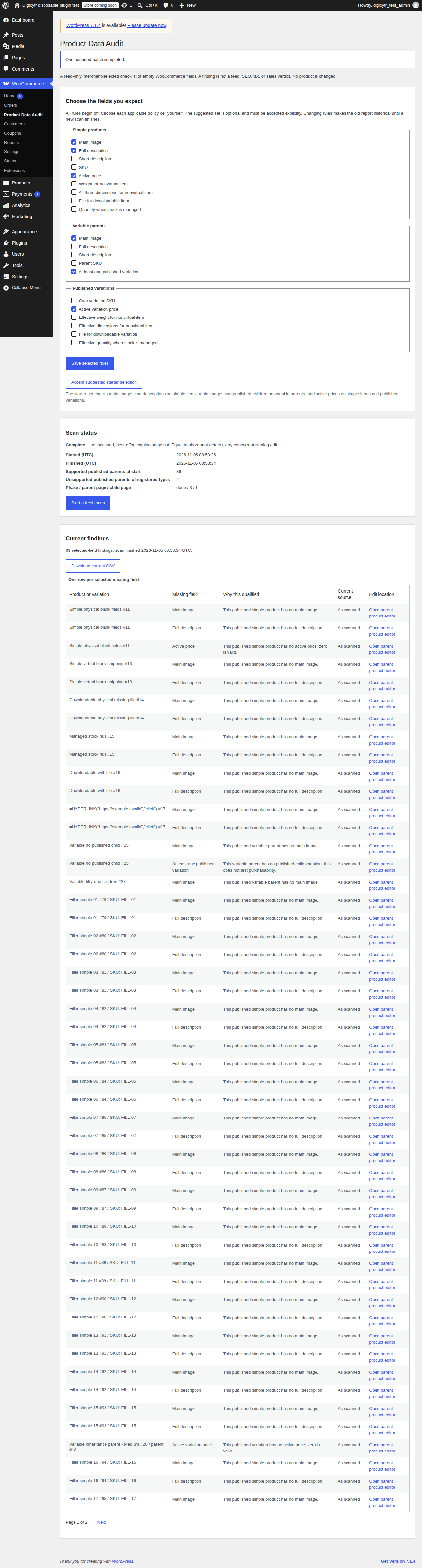
Example screenshot from a disposable test site.
Install and use
Upload the versioned ZIP at Plugins → Add New → Upload Plugin with WooCommerce active. The plugin declares WordPress 7.1+, PHP 8.3+, and WooCommerce 8.9.0+; see the QA record for exact tested versions. A dependency notice appears if WooCommerce is inactive or below the tested floor.
- In WooCommerce → Product Data Audit, choose the field rules you expect and save. All rules start off. You can explicitly accept the suggested starter set, then review it. Selection is stored in
dpda_rules_v1and each scan snapshots it. - Select Start a fresh scan, then Continue one batch until Complete. A request processes at most 25 published simple/variable parents or 50 published variations of one variable parent. Scanning is manual, resumable, and serialized. A scan that detects changed totals, changed rules, or query/storage errors is Incomplete; start afresh. No cron or background job runs.
- Read the private report. It shows the exact selected missing field, why the product qualified, source freshness, variation ID/SKU and parent editor link when permitted. The report is an as-scanned, best-effort snapshot: equal totals do not prove an unchanged catalog. Unsupported registered published parent types are counted, not inspected. Unknown/unregistered types are outside that count.
- Export only the active Complete report under the current selected rules. CSV columns are
scan_finished_at_utc,parent_id,subject_id,product_type,product_name,sku,rule_key,reason,edit_url. It rejects more than 20,000 findings rather than truncating. Every text cell is protected against spreadsheet formulas; edit URLs are blank unless you can edit that product.
Rule semantics
Parent descriptions and main images are separate optional policies. A variable parent is never required to have a price. Variation images are never required; variations may inherit an image. A variation SKU rule checks its own SKU (edit context), while variation weight, dimensions, and managed stock use effective view-context values, including inheritance. Blank price is missing; 0 is valid. Weight and dimensions are skipped only for virtual products; downloadable physical products still qualify. Download files are required only when a selected rule applies to a downloadable product. Stock quantity is checked only when stock management is enabled; 0 is valid. “Published variations” counts status only and says nothing about storefront availability or purchasability. Extension-managed prices or fields may need their rules disabled.
Privacy and lifecycle
Access to settings, scan, report and CSV requires manage_woocommerce; actions and export also require a nonce. Data is stored in three plugin-owned InnoDB tables: run state, processed-subject ledger and missing-field findings. A non-autoloaded option mirrors the latest scan state for recovery. Product names and SKUs are retained as report snapshots, not refreshed silently. No orders, customers, remote calls or front-end output are involved. Deactivation retains settings and reports; uninstall drops the three tables and deletes plugin options. Manual ZIP updates are used; the unique Digicyfr Update URI prevents an unrelated directory update. There is no automatic update endpoint.
Development
find . -type f -name "*.php" -not -path "./dist/*" -print0 | xargs -0 -r -n1 php -l
find assets -type f -name "*.js" -print0 | xargs -0 -r -n1 node --check
python3 tools/build_plugin.py digicyfr-product-data-audit
python3 tools/verify_zip.py dist/digicyfr-product-data-audit-0.1.0.zip --slug digicyfr-product-data-audit --against-source
(cd dist && sha256sum --check digicyfr-product-data-audit-0.1.0.zip.sha256)
bash tests/run-wordpress-integration.sh dist/digicyfr-product-data-audit-0.1.0.zip 8.9.0 legacy
bash tests/run-wordpress-integration.sh dist/digicyfr-product-data-audit-0.1.0.zip 11.2.2 hpos
License: GPL-2.0-or-later; see LICENSE.
The integration command requires Docker Compose and a working Docker daemon. It installs the built ZIP on a disposable WordPress site and removes its volumes afterward.
Source, support and security
Source and ordinary bug reports: https://github.com/digicyfr/digicyfr-product-data-audit and its Issues tab. For sensitive reports, follow SECURITY.md. Contributions are welcome under CONTRIBUTING.md. The public release snapshot is recorded on release/0.1.0; main is for ongoing work. See RELEASE_NOTES.md and docs/QA-0.1.0.md before distribution.