Install
This is the repository archive. It installs, but the folder name will carry the branch suffix and updates will not flow.
Install straight from GitHub with WP-CLI:
wp plugin install https://github.com/deepquest-io/directory-watch/archive/refs/heads/main.zipA WordPress.org plugin that tells you when a plugin or theme you run is closed, removed, renamed or handed to a new owner.
You installed it in 2024. It was closed for a security problem in 2026. Nothing on your site changes: the code keeps running, updates keep arriving from wherever they're hosted, and your dashboard looks exactly the same. This plugin is the missing alarm.
- No account, no cloud, no telemetry, no configuration required
- No database tables, no files written — two options, one of them autoload-disabled
- WordPress 5.8+ · PHP 7.4+ · core APIs only
Screenshots
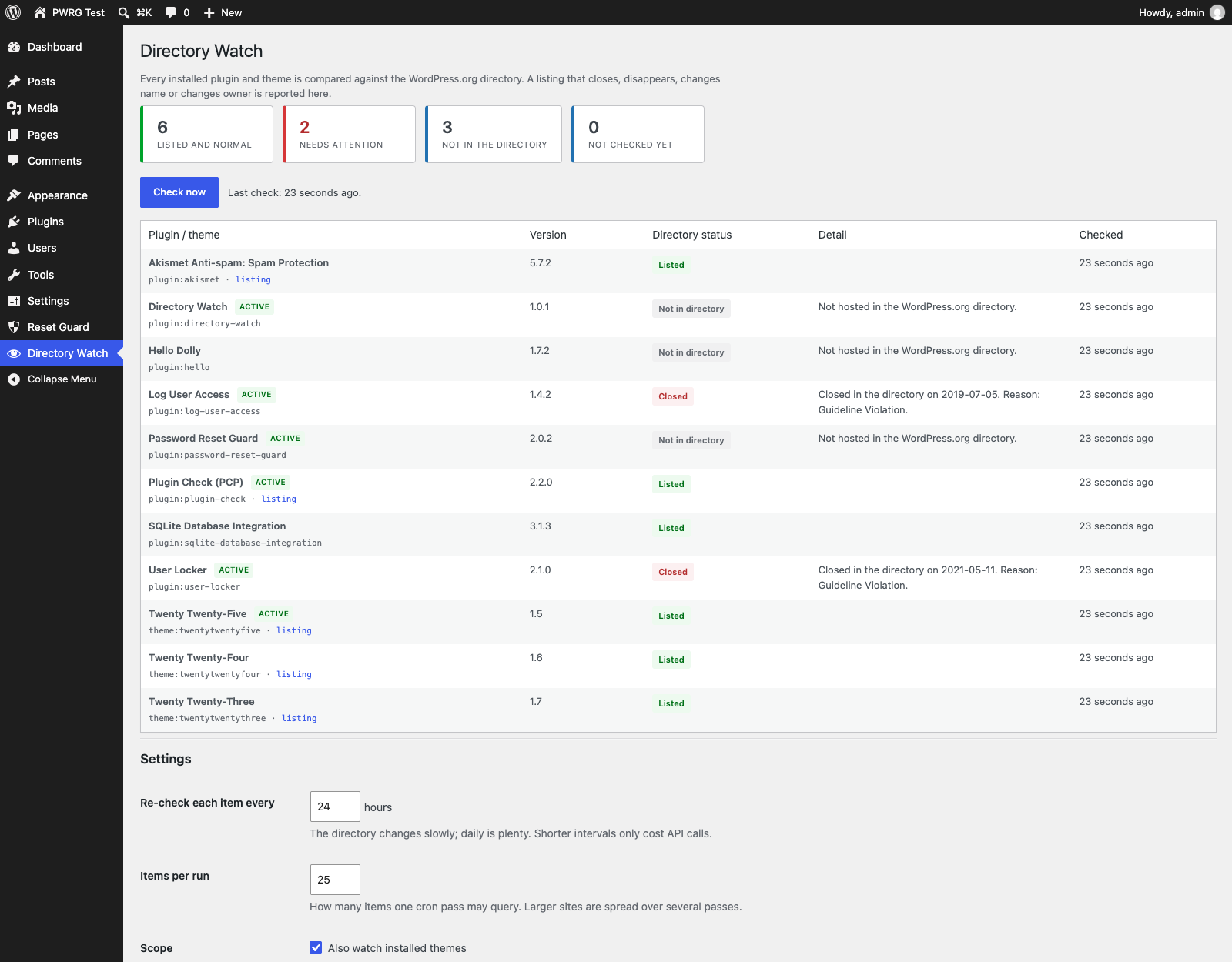
The inventory — every installed plugin and theme with its directory status. Closed listings carry the closure date and the reason the directory gave.
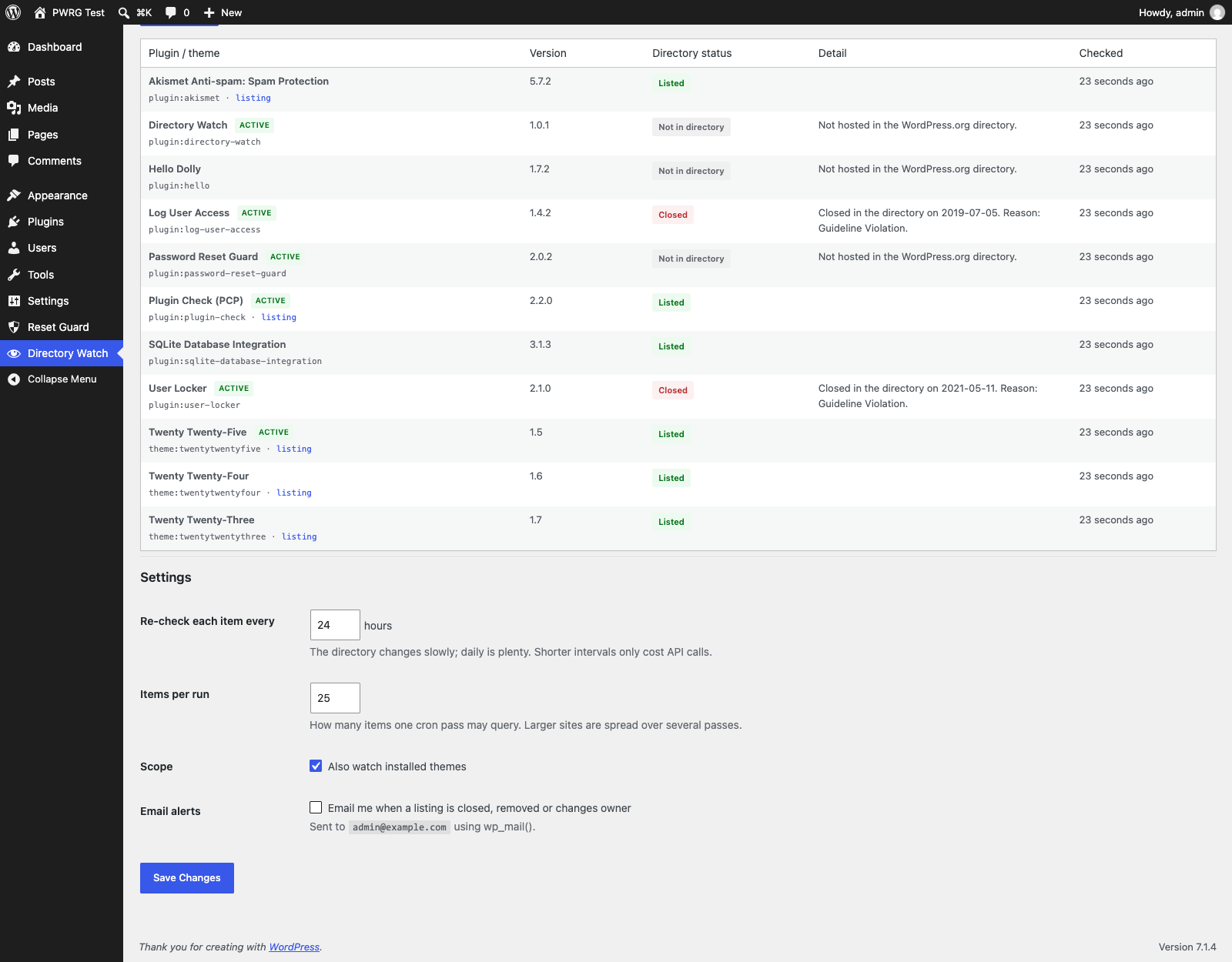
Settings — check interval, batch size, theme scope and email alerts. All optional; the defaults work.
What it detects
| Status | Meaning | What triggers it |
|---|---|---|
| Closed | The directory disabled downloads for that slug. Usually a security or guideline action. The closure date and stated reason are shown. | 404 with {"error":"closed"} |
| Removed | The slug was listed before and is no longer there. | Any other API error, with a baseline saying it was previously listed |
| New owner | The author changed. A transfer means new code can ship under a name you already trust — the quietest way for a plugin to change hands. | Author string differs from the baseline |
| Renamed | The listing presents a different name. | Name differs, author unchanged |
| Listed again | A slug that had gone missing is back. | Previously in_directory: 0, now healthy |
| Not in directory | Custom plugins, premium bundles, marketplace themes. | Never listed, and never previously listed |
That last row is what makes the tool usable. A naive check flags every private plugin as removed on the first run and trains you to ignore the alarm. A slug that was never listed cannot raise one.
How it works
- Inventory —
get_plugins()andwp_get_themes(), keyedplugin:<slug>/theme:<slug>, with active state taken from bothactive_pluginsand the multisite network option. - Due selection — an hourly WP-Cron event, but each item is re-queried only once per
check_hours(default 24). The cron fires constantly; real work happens once a day. - Lock — a five-minute transient, so overlapping cron ticks and a manual check cannot stack.
- Query — one HTTPS GET per item to
api.wordpress.org, withsections,screenshots,description,versions,iconsandbannersdisabled to keep the payload small. 8 s timeout, 1 redirect, 256 KB body cap. - Compare — the fresh record against the stored baseline, with authors and names normalised (tags stripped, entities decoded, whitespace collapsed, lowercased) because the API returns author as markup.
- Record — a status change appends to a 200-entry history and, for
closed/removed/transferred, sends a single email.
A soft 20-second budget stops a batch cleanly on hosts with tight execution limits; large inventories finish over several passes instead of being killed mid-request.
Design rules
A transport failure is never an alert. Timeout, HTTP 500, unparseable JSON — the previous verdict stands, the error is recorded beside the row, nothing is emailed. A flaky host cannot fabricate a closure.
First sight never alerts. The first pass establishes the baseline. Everything after it is real drift.
Only api.wordpress.org is contacted. The URL is built from a sanitised slug inside the plugin. No endpoint setting, no user-supplied host, no way to point it at an internal address.
Installation
From the admin: Plugins → Add New → Upload Plugin → choose the zip → Install → Activate. Then open Directory Watch and press Check now.
From git:
cd wp-content/plugins
git clone https://github.com/deepquest-io/directory-watch.git
Requires outbound HTTPS to api.wordpress.org — the same host WordPress already contacts for update checks.
Settings
| Setting | Default | Notes |
|---|---|---|
| Re-check interval | 24 hours | 1–168. The directory changes slowly; daily is plenty. |
| Items per run | 25 | 1–100. Larger sites spread over several cron passes. |
| Watch themes | on | Turn off for plugin-only monitoring. |
| Email alerts | off | Sent to the admin address via wp_mail(). |
Hooks
// Add a status to the ones that trigger email.
add_filter( 'dw_alert_statuses', function ( $statuses ) {
    $statuses[] = 'renamed';
    return $statuses;
} );

// Change settings at runtime without touching the option.
add_filter( 'dw_settings', function ( $settings ) {
    $settings['per_run'] = 50;
    return $settings;
} );
Security
No SQL — state lives in the options API, so there is no injection surface. No filesystem writes. No eval, exec, system or unserialize. Every admin action is capability-gated on manage_options and nonce-verified; every output is escaped. The API host is fixed and slugs pass through sanitize_key(), so the client cannot be redirected (verified against traversal and full-URL payloads). Response bodies are size-capped before decoding, and an HTTP 404 is parsed rather than mistaken for a network failure.
The full review — findings, control matrix, residual risks, reproduction steps — is in SECURITY-AUDIT.md. Two of the defects documented there were found by tests, and one by a live production run, not by reading the code.
Found a problem? Open an issue with steps to reproduce.
Compatibility
WordPress 5.8+ · PHP 7.4+ · single site and multisite · no dependency on any theme, page builder or caching plugin. Uninstall removes both options, the transients and the cron event on every site of a network.
Known limitations
- A silent code change within a version is invisible. Same author, same name, same version string, different code — that is a malware scanner's job.
- Premium and custom plugins are reported as Not in directory; they cannot be monitored this way.
- A transfer that keeps the same author string (a company account changing hands internally) is not detectable.
- Single-file plugins whose directory slug differs from the filename —
hello.phpishello-dollyin the directory — read as Not in directory. It errs towards silence; multi-file plugins are unaffected.
License
GPL-2.0-or-later. See LICENSE.