Congregation: Church Management
Church management for WordPress: volunteer rotas that fill every place without double-booking or overloading anyone, signed accept/decline links with automatic replacement, giving statements, and sermons with a podcast feed.
Install
This is the repository archive. It installs, but the folder name will carry the branch suffix and updates will not flow.
Install straight from GitHub with WP-CLI:
wp plugin install https://github.com/coderock-izzy/wordpress-church-suite/archive/refs/heads/main.zipCongregation: Church Management for WordPress
A WordPress plugin for running a church's week-to-week life from its own website:
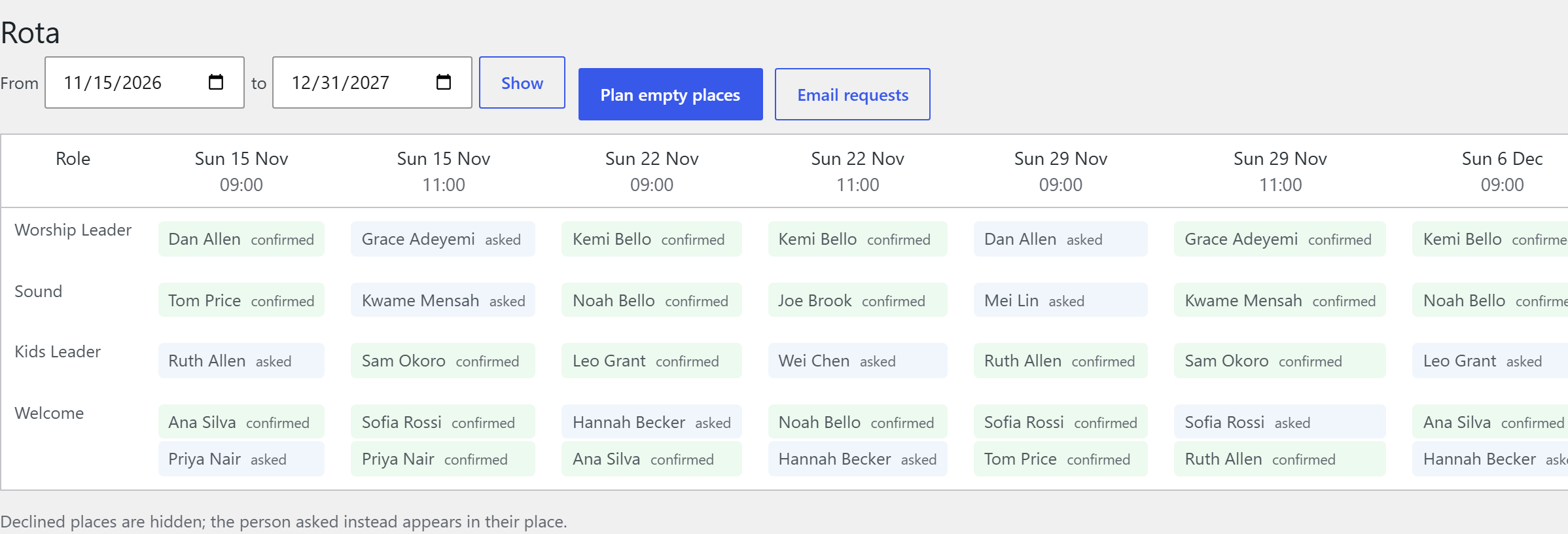
- Volunteer rotas that fill every place without overloading anyone. People answer "Can you serve?" from a link in their email, and anyone who declines is replaced automatically.
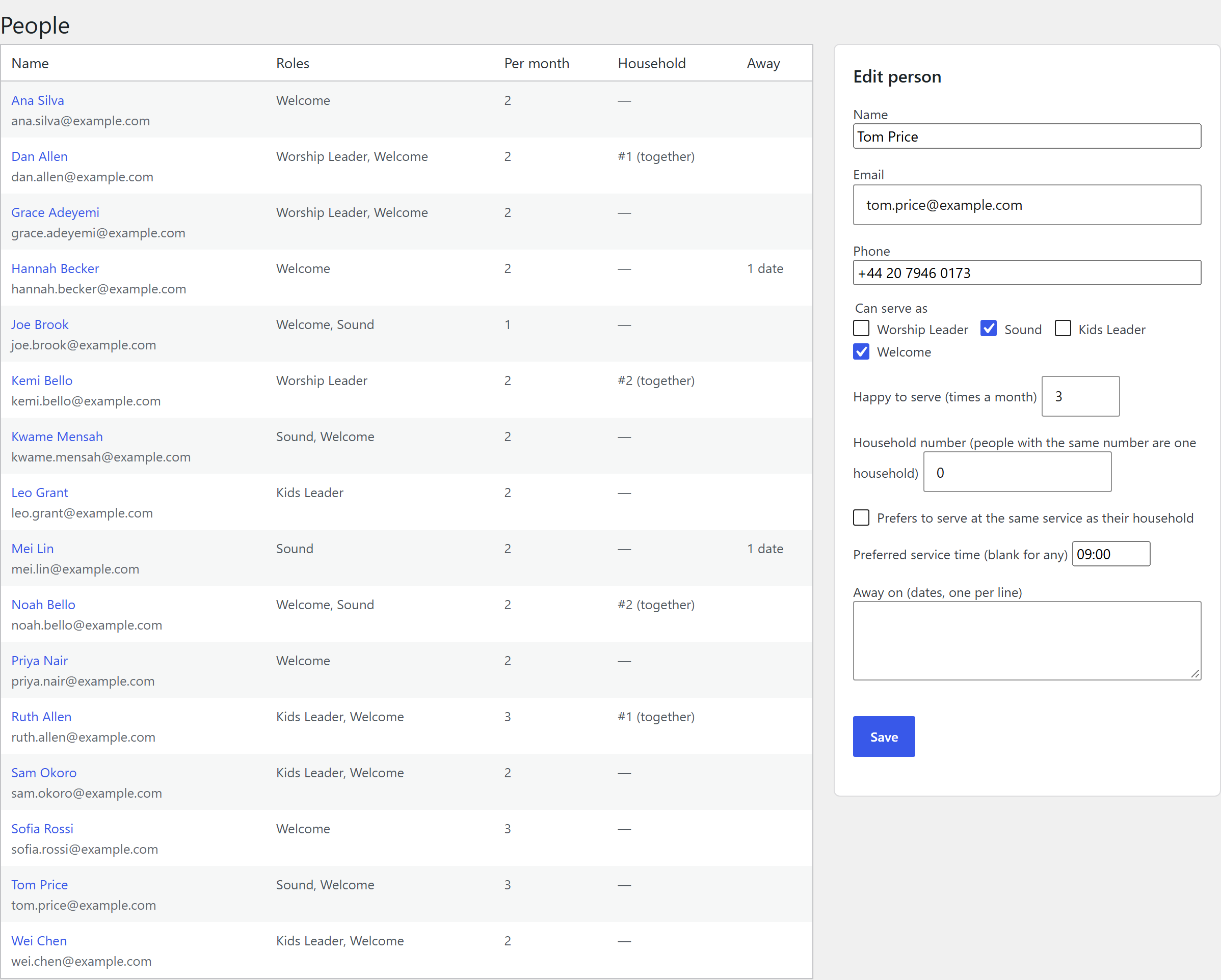
- People and households.
- Giving records with year-end statements.
- Sermons with an archive and a podcast feed that podcast apps accept.
The rota is where most of the work goes. In most churches, each team leader keeps their own spreadsheet. Nobody can see that the same person is on sound and welcome at 11:00, or that someone who offered one Sunday a month is down for three. The reliable few get asked every week until they burn out, while a quarter of the people who offered to help are never asked at all.
Results
php eval/run.php --gate simulates churches over a quarter (13 Sundays). Each volunteer can do one to three roles,
offers one to four Sundays a month, is away for a holiday or two, may prefer one service time, and may want to serve
alongside their household. Some roles have only one or two trained people. After the rota goes out, some people
decline and must be replaced. The scheduler's weights were set on 15 tuning churches. These are 40 held-out
churches (3,030 volunteers, 12,896 places):
| Rota made by | Places filled | Filled after declines | Two roles at one service | Over a person's monthly limit | Volunteers never asked | Back-to-back Sundays | Households split |
|---|---|---|---|---|---|---|---|
| Team spreadsheets (each leader rotates their own list) | 93.2%* | 90.0% | 1,141 | 2,337 | 3.1% | 25.3% | 24.1% |
| One coordinator, first person who can | 88.5% | 86.1% | 0 | 0 | 26.2% | 34.1% | 5.6% |
| This plugin | 90.9% | 88.5% | 0 | 0 | 0.1% | 11.1% | 1.1% |
* Team spreadsheets look fullest only because 1,141 of their places go to someone already serving elsewhere at that service. Counting those as empty, they cover about 84%.
On churches held back with a different shape (very small: 18 to 26 volunteers, one service; very large: 140 to 200 volunteers, three services), the plugin filled 91.9% against 91.1%. It broke no rule, asked everyone at least once, and split no household.
What the numbers show:
- Rules a spreadsheet can't see are the ones that break. With per-team lists, a person is double-booked at one service about once in every eleven places, and asked beyond their monthly limit over 2,000 times a quarter.
- Fairness and coverage come together. A careful coordinator who keeps every rule still leans on whoever is first on the list: a quarter of volunteers never serve, and those who do serve back-to-back a third of the time. Sharing places by how much each person offered fills more places (scarce roles first) and spreads the load.
- Some places can't be filled by anyone. At least 9% of places went unfilled under every method that keeps the rules, because there are not enough trained, available people. The plugin reports them as "nobody free" so they get sorted out by hand, with time to spare.
How it works
plan ─► scarcest places first (fewest people trained and free that day)
        ─► each to the person with the lowest score:
             share of their offered capacity already used
             + 1.0 if they serve the week before or after
             + 1.0 if their household serves at another service that day (when they asked to serve together)
             + 0.3 if it is not their preferred time (- 0.15 if it is)   + 0.6 if they already serve elsewhere that day
        ─► repair: an empty place is filled by moving someone whose other place another person can take
ask  ─► email with signed Accept / Decline links (no login needed)
─► decline: the best other person who can is asked at once; if nobody can, the office is emailed- Hard rules are never broken: only trained roles, never on dates away, one role per service, and within each person's monthly limit. See ADR 1.
- Answer links carry an HMAC of the place and the person it was sent to. A forwarded link stops working once the place goes to someone else. See ADR 2.
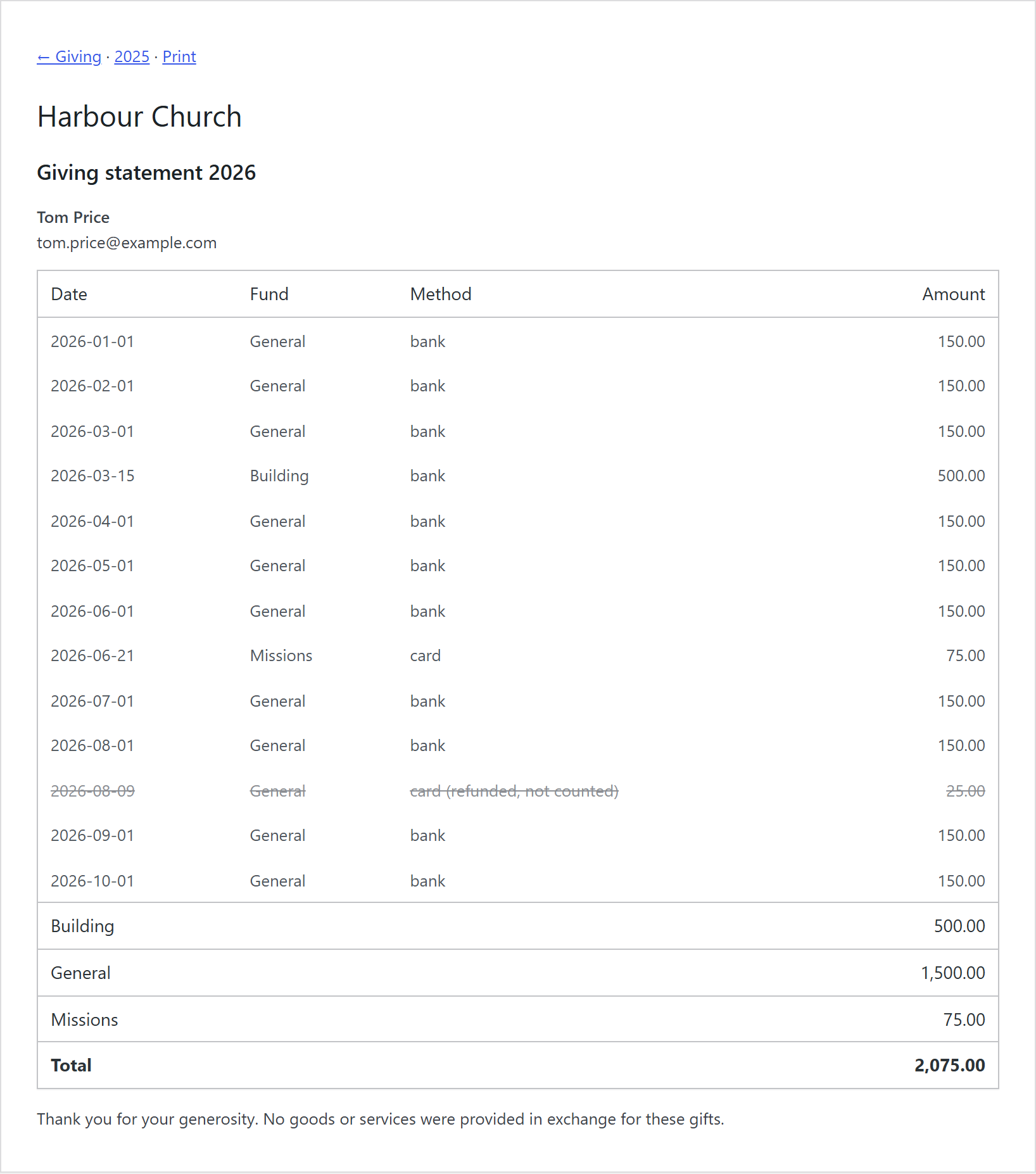
- Giving is stored in whole cents. Statements list every gift in the year, show refunds without counting them, and total by fund. Privacy erasure keeps the amounts but removes the name, because charities must keep financial records. See ADR 3.
- Sermons are a post type with speakers, series, scripture and audio. The feed at
/feed/sermons/is RSS 2.0 with iTunes tags and a sized enclosure per episode.
Decisions: docs/adr. Gaps: docs/known-limitations.md.
Run it
composer install
vendor/bin/phpunit                 # unit tests (scheduling, statements, tokens)
vendor/bin/phpcs                   # WordPress coding standards
vendor/bin/phpstan analyse         # level 8 with WordPress stubs
php eval/run.php --gate            # eval/reports/report.{md,json,html}

docker compose up -d && bash tests/integration/run.sh
# open http://127.0.0.1:8080/wp-admin/admin.php?page=congregation (admin / admin)
Shortcodes: [congregation_sermons series="slug" count="10"] and [congregation_my_rota] (the logged-in member's
upcoming places).
Tests and CI
- Unit: hard rules on a full month, load shared by what people offered, scarce roles first, repair (and that places which already existed are never moved), household, preference and spacing, replacement after a decline, statement totals across refunds and years, money parsing, and answer tokens.
- Integration (real WordPress): a month of rota planned with no double booking or over-limit place, re-planning adds nothing, requests sent once, a forged link refused, a decline replaced and the new person emailed, accept after decline refused, giving statements, the sermon list, privacy export and erasure, and the member's own rota. Over HTTP: the emailed accept and decline links, the podcast feed parsed as XML, and uninstall.
- CI: WPCS and PHPCompatibility, PHPStan level 8, PHPUnit on PHP 8.1 to 8.4, the evaluation gate, the integration suite on WordPress 6.5 and the latest release, and a gitleaks scan of the full history.
License
GPL-2.0-or-later