MDF Analytics WP Registry grade A. No security issues foundWP RegistryNo security issues foundOpen the reportA
WordPress plugin for MDF (Markdown First) — tracks AI agent traffic and Accept: text/markdown requests with an earnings dashboard.
Install
Upload it under Plugins → Add New Plugin → Upload Plugin, then activate.
Install straight from GitHub with WP-CLI:
wp plugin install https://github.com/bitcryptic-gw/mdf-analytics-wp/releases/download/v0.1.13/mdf-analytics-0.1.13.zipMDF Analytics for WordPress
A WordPress plugin that gives you visibility into AI agent traffic hitting your site — and, since v0.1.4, lets you start serving clean markdown to agents that ask for it.
Part of the MDF (Markdown First) ecosystem.
The problem
Automated clients now account for the majority of web traffic. In June 2026, Cloudflare Radar data showed bots generating 57.5% of HTML requests across Cloudflare's network, against 42.5% from humans — the first time automated requests crossed into the majority. AI agents are the fastest-growing slice of that traffic. Most of them are silently scraping your content, burning tokens to parse HTML, and moving on — with no signal to you and no value exchange in either direction.
MDF proposes a better model: serve clean markdown directly to agents via HTTP content negotiation, with access policy expressed through price. This plugin gives you visibility into that traffic first, and an opt-in path to start serving markdown.
What it does
MDF Analytics classifies every request to your WordPress site — known AI agent, likely automated client, internal/monitor, or human browser — and logs the relevant data. As of v0.1.4, it can also serve markdown directly: turn on "Offer markdown to agents" in Settings, and requests sending Accept: text/markdown receive a pre-generated CommonMark version of the page instead of HTML, at the same URL (Vary: Accept). Browsers are unaffected.
The dashboard shows you:
- How many AI agents are hitting your site, and which ones
- Whether any are already sending
Accept: text/markdownheaders - What you would have earned if you'd been serving paid markdown content (payments are not yet implemented — see Roadmap)
- A daily trend chart of inbound agent traffic
- A separate table for internal/monitor traffic (uptime checkers, WordPress core calls) so they don't inflate your agent counts
Nothing leaves your site. No external API calls, no analytics beacons, no phoning home. All data is stored in your WordPress database and purged after 90 days.
Installation
The plugin is multi-file as of v0.1.4 — it ships a vendored, namespaced copy of league/html-to-markdown in vendor/, which mdf-analytics.php requires to load.
Do not upload
mdf-analytics.phpon its own. Without thevendor/directory alongside it, WordPress will fatal-error on activation.
Recommended: install from a packaged release
- Go to the Releases page and download the release asset for the version you want (e.g.
mdf-analytics-0.1.9.zip). Download the named release asset, not the auto-generated "Source code (zip)" link. - In your WordPress admin, go to Plugins → Add New → Upload Plugin.
- Upload the zip and click Activate.
- Find MDF Analytics in the left admin menu.
Alternative: install from the source archive
Code ▸ Download ZIP on this repository also produces a working install — vendor/ is source-committed, so no Composer step is required. Note that GitHub names the source archive after the repository and branch, so it extracts to a plugin directory called mdf-analytics-wp-main/ rather than mdf-analytics/. This matters if you later need to locate the plugin's bundled llms.txt (see below) or reference the plugin path in server config.
After activation
The plugin starts logging immediately. To also serve markdown to agents, go to Settings and enable "Offer markdown to agents."
Markdown does not start serving instantly. Enabling the toggle queues a background backfill that converts your published posts and pages to markdown. Until that backfill completes — typically a few minutes on a small site, longer on large ones — your pages will continue to return HTML even to agents sending
Accept: text/markdown. This is by design: markdown is never served for a URL until a pre-built file exists for it. The Settings page shows a coverage line ("N of M published posts/pages have a cached markdown version") so you can watch progress.
Dashboard
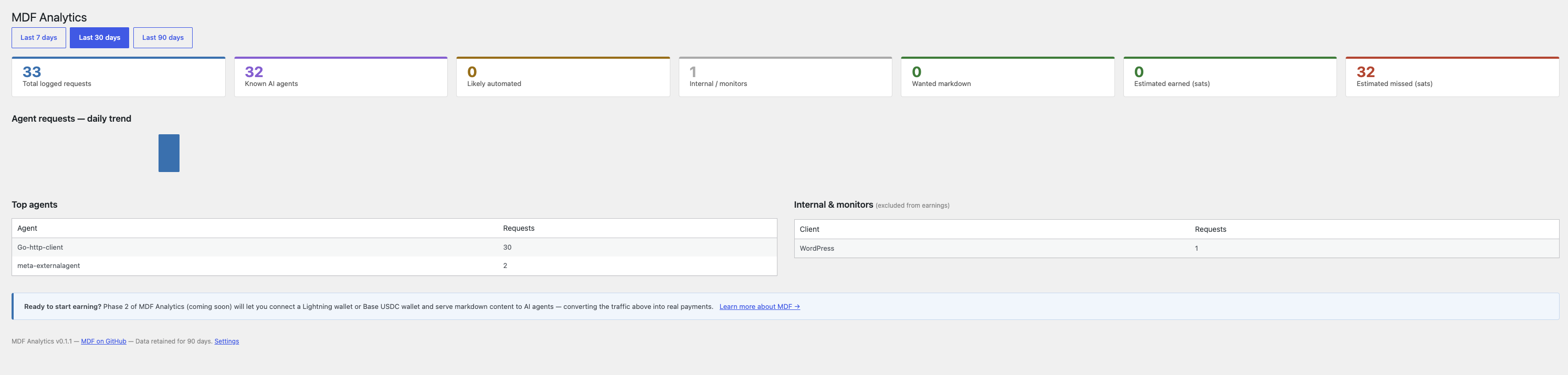
Stat cards
| Card | What it means |
|---|---|
| Total logged requests | All non-human, non-asset requests in the selected window |
| Known AI agents | Matched against a curated list of ~40 known agent UA fragments |
| Likely automated | No browser engine markers, not a known agent — probably a script or framework |
| Internal / monitors | WordPress core, uptime monitors, CDN health probes — excluded from earnings |
| Wanted markdown | Requests that included Accept: text/markdown |
| Estimated earned | What you'd have received if markdown was live and priced at your configured rate |
| Estimated missed | What inbound agents could have paid — the opportunity cost |
Time windows
Switch between last 7, 30, or 90 days. Default is 30 days.
Settings
Configure your preferred currency (sats via Lightning or USDC via Base) and the per-request rate used for estimated earnings calculations. The defaults are 1 sat and $0.001 USDC — broadly in line with MDF micropayment tier pricing.
This is also where you enable "Offer markdown to agents" — the toggle that turns on markdown serving for requests sending Accept: text/markdown. When enabled, a coverage status line below the toggle reports backfill progress while it runs, and cached-vs-published counts once it completes.
llms.txt serving
The plugin ships a generic, owner-editable llms.txt template in the plugin directory and serves it virtually at the site root (/llms.txt) — nothing is ever written to your WordPress installation's actual root directory.
To customise it, edit the template file inside the plugin directory (wp-content/plugins/<plugin-dir>/llms.txt, where <plugin-dir> depends on how you installed — see Installation above). There is no in-admin editor for this file. Edit the placeholder sections (site summary, key pages) to describe your own site; the "Machine-readable content" section at the bottom, which tells agents this site negotiates markdown via Accept: text/markdown, doesn't need editing. Changes are picked up immediately by the virtual handler.
If your site already has a real, static llms.txt file at the web root: the web server serves that file directly, before WordPress ever runs, so the plugin's own copy is silently shadowed and never seen — this is standard static-file precedence, not a bug. As of v0.1.8, the plugin detects this at activation (and keeps rechecking) and shows a dismissible admin notice explaining that your existing file takes priority, with a one-click copy of just the "Machine-readable content" snippet so you can add markdown-negotiation support to your existing file by hand if you want it. The plugin never reads, edits, or deletes your existing file.
Requests to /llms.txt (the plugin's own virtual copy) appear in the analytics dashboard alongside other agent traffic, classified through the same visitor classifier.
On uninstall (not deactivation — deactivating leaves everything in place), the plugin removes its own data: the database table, all generated markdown cache files, and its options. It never touches a web-root llms.txt, static or otherwise, since it never created one.
Because customisations live in the plugin directory, they are overwritten when you upgrade the plugin. Keep a copy of your edited
llms.txtoutside the plugin directory and re-apply it after upgrading, until an in-admin editor ships.
Markdown serving
Since v0.1.4, the plugin pre-builds and caches a CommonMark version of each post and page. When "Offer markdown to agents" is enabled and a request sends Accept: text/markdown, the cached markdown is served at the same URL with a Vary: Accept header; all other requests receive HTML as normal, with no Vary header added.
Conversion is handled by the vendored league/html-to-markdown library.
Known limitations
- WP Super Cache — reverse race condition. As of v0.1.7, the plugin sets
DONOTCACHEPAGEbefore serving markdown, which stops WPSC from caching a markdown response under a key that could later be served to HTML requesters. The reverse direction is not yet fixed: if WPSC caches the HTML response for a URL first, markdown requests to that same URL can be blocked from ever reaching an agent, because WPSC'swpsc_get_accept_header()mapstext/markdowntotext/htmlinternally and treats them as the same cache entry. Fixing this fully requires a change in WP Super Cache's own plugin extension directory, not just this plugin. If you run WP Super Cache, be aware the dashboard's "wanted markdown" figures may undercount on cached URLs. - HTML entity decoding. Standard HTML entities (e.g.
&) are currently preserved as-is in converted markdown rather than decoded, so agents may see&where a human reader would see&. This doesn't break parsing but is cosmetically imperfect. - No in-admin
llms.txteditor. Customising the discovery file requires editing it inside the plugin directory, and those edits do not survive a plugin upgrade.
Agent classification
Visitors are classified into four types:
- Type 2 — Known agent: UA string matches a fragment from the curated list. Includes Claude, GPT, Gemini, Perplexity, common crawler bots, Python/Go/Node HTTP clients, and major agentic frameworks.
- Type 1 — Likely automated: No browser engine markers (
Mozilla/,WebKit,Gecko, etc.) and not a known agent. Conservative heuristic — leans toward false negatives over false positives. - Type 3 — Internal/monitor: Matches platform self-calls and monitoring tools. WordPress core, Uptime Kuma, UptimeRobot, Pingdom, and similar. Logged but excluded from all agent counts and earnings figures.
- Type 0 — Human: Has browser engine markers. Not logged unless they also send
Accept: text/markdown.
Only types 1, 2, and 3 — plus any Accept: text/markdown requests — are written to the database. Ordinary human browser traffic is not logged, keeping the table lean.
Roadmap
Phase 2 — Wallet integration & paid markdown
Connect a wallet and start serving real 402 responses to agents that request markdown, with price-gated access enforced via the x402 payment rail. Blocked on the upstream payment-verification oracle reaching commercial launch — see CHANGELOG.md for status.
Markdown generation itself (previously listed as "Phase 3") already shipped in v0.1.4 — see Markdown serving above.
Part of the MDF ecosystem
MDF (Markdown First) is an open web standards proposal that makes AI agents first-class content consumers via HTTP content negotiation. Same URL, same domain — agents that send Accept: text/markdown get clean markdown; browsers get HTML. Access policy is expressed through price using x402 (EVM/stablecoin) and L402 (Bitcoin/Lightning) payment rails.
- Spec: github.com/bitcryptic-gw/mdf
- Reference implementation: github.com/bitcryptic-gw/mdf-reference-server
- Live demo: mdf-demo.bitcryptic.com
Changelog
See CHANGELOG.md for the full version history.
| Version | Date | Summary |
|---|---|---|
| 0.1.9 | 2026-09-01 | Fix: backfill and per-post rebuild recovery when the scheduled cron event is lost to a race with another scheduler — scheduling is now verified and retried, with a self-heal recheck on existing crons and admin page loads. Added: persistent markdown-coverage status line on the Settings page. See CHANGELOG.md. |
| 0.1.8 | 2026-09-01 | Added: uninstall hook removes the DB table, markdown cache directory, plugin options, and scheduled events. Added: activation-time detection + dismissible admin notice for a pre-existing static /llms.txt, with a copy-paste "Machine-readable content" snippet. Changed: bundled llms.txt replaced with a generic owner-editable template. See CHANGELOG.md. |
| 0.1.7 | 2026-07-16 | Fix: DONOTCACHEPAGE set before serving markdown, preventing WP Super Cache from sharing a cache key between markdown and HTML responses for the same URL. Fix: page-builder shortcode expansion (e.g. Divi) now works correctly in WP-Cron context. See CHANGELOG.md. |
| 0.1.6 | 2026-07-16 | Fix: backfill no longer counts failed conversions as processed. Added: writability check + admin notice for the markdown cache directory. Roadmap copy updated — markdown generation is shipped, not Phase 3. See CHANGELOG.md. |
| 0.1.4 | 2026-07-09 | Vendored, namespaced league/html-to-markdown. Pre-build markdown cache pipeline with negotiation gating and file_exists() gate. flock(LOCK_EX) manifest locking. Markdown serving goes live in this release. See CHANGELOG.md. |
| 0.1.3 | 2026-06-10 | Added: plugin serves curated llms.txt at the site root (/llms.txt). Supports GET/HEAD, conditional requests, and 1-hour caching. Requests logged through existing classifier. See CHANGELOG.md. |
| 0.1.2 | 2026-06-10 | Fix: known-agent snippets now show matched fragment (e.g. Googlebot) rather than raw UA prefix (Mozilla) |
| 0.1.1 | 2026-06-09 | Fix: WordPress core, Jetpack, and uptime monitors correctly classified as internal/monitor and excluded from earnings |
| 0.1.0 | 2026-06-08 | Initial release |
There is no v0.1.5 — the version was skipped.
Requirements
- WordPress 6.0+
- PHP 8.0+
- MySQL 5.7+ or MariaDB 10.3+
No Composer or npm runtime dependency — the plugin ships its dependencies vendored.
License
MIT — copyright Gary Walker (BitCryptic™) and Graham Hall (Slepner).
Releases
12 releases. Each count is every asset in that release; expand a row for the breakdown.