Install
This is the repository archive. It installs, but the folder name will carry the branch suffix and updates will not flow.
Install straight from GitHub with WP-CLI:
wp plugin install https://github.com/bennethade/paystack-integration-health-checker/archive/refs/heads/main.zipA WordPress plugin that systematically diagnoses Paystack payment integrations: configuration, API connectivity and authentication, webhooks, WooCommerce compatibility, and the payment flow. Every finding states its status (PASS, WARNING, FAIL or SKIPPED), the evidence behind it, and what to do next.
Independent project. Not affiliated with, endorsed by, or supported by Paystack. "Paystack" names the service being diagnosed.
Read-only by design. The checker never creates payments, never changes orders, gateway settings or store settings, and never displays, logs or exports secret keys.
Contents
- The problem it solves
- Features
- Screenshots
- Architecture
- Requirements
- Installation
- Configuration
- Running diagnostics
- Understanding diagnostic statuses
- Safe test-mode payment verification
- Understanding webhook checks
- Implemented checks
- Security model
- Automated testing
- Known limitations and unverified scenarios
- Troubleshooting
- Future improvements
1. The problem it solves
When a Paystack payment "doesn't work", the cause can sit in any of a dozen places:
- Keys: a key from the wrong environment, a public key pasted into a secret field, or a rotated key.
- Network: a firewall, DNS or TLS problem between the server and
api.paystack.co, or IP whitelisting on the Paystack account. - Webhooks: a webhook URL that is wrong, redirects, or is unreachable from the internet.
- WooCommerce: a gateway that is missing from the Checkout block, is incompatible with HPOS, or doesn't support the store currency.
- Order updates: a payment that succeeded at Paystack but never reached the order.
Merchants and support engineers usually check these by hand, one at a time. This plugin runs the checks in one place, keeps the evidence, and states clearly what it could and could not verify.
2. Features
- Dashboard:
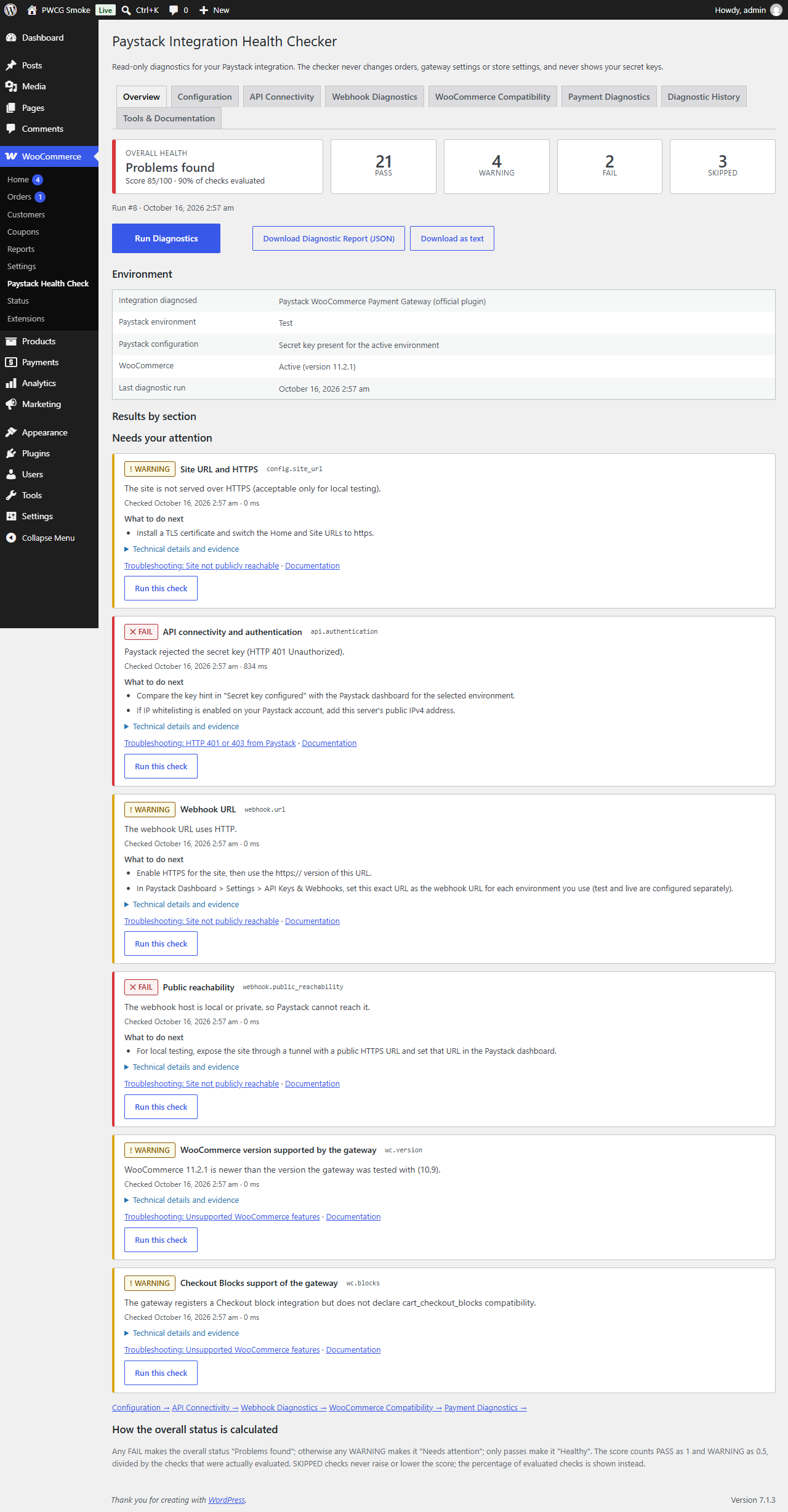
- overall health, a score, and PASS/WARNING/FAIL/SKIPPED counts;
- the last run, the test or live environment (never the keys), WooCommerce status and Paystack configuration status;
- Run Diagnostics and Download Diagnostic Report actions.
- 31 registered checks (30 in the full run, plus the manual signed webhook test) across environment, configuration, API connectivity, webhooks, WooCommerce compatibility and payment flow, plus reference verification (see §12). Each check can also be re-run on its own.
- A real, documented API request.
GET /integration/payment_session_timeoutwith the configured secret key confirms connectivity and authentication. It classifies DNS, TLS, timeout, connection, 401, 403, 429, 5xx, invalid-JSON and API-level failures. - Webhook diagnostics that only call the site's own webhook URL. They include an explicitly confirmed, signed non-payment test event.
- WooCommerce compatibility read from WooCommerce itself: gateway HPOS and
cart_checkout_blocksdeclarations, Checkout-block registration, and version ranges. The gateway's compatibility is reported separately from the checker's own. - Payment Diagnostics:
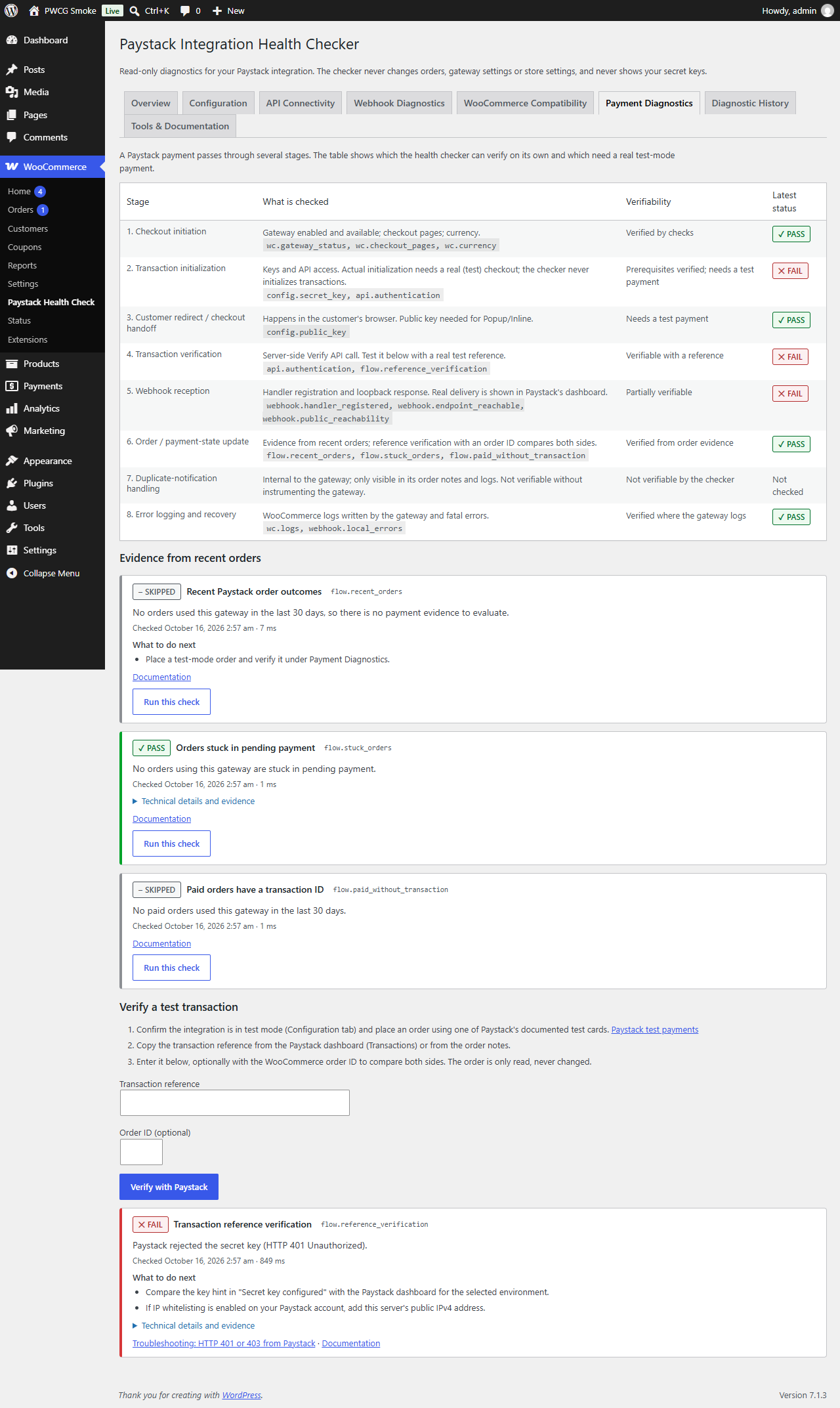
- a stage map showing what can and cannot be verified;
- evidence from recent orders (counts only);
- reference verification that compares Paystack's answer with an order, read-only.
- Supported integrations:
- the official Paystack WooCommerce Payment Gateway (
woo-paystack); - Gateway for Paystack on WooCommerce (
paystack-woocommerce-gateway); - manual keys for custom integrations or sites without WooCommerce.
- the official Paystack WooCommerce Payment Gateway (
- History with run-to-run comparison, configurable retention, deletion, and sanitized JSON or text reports.
- Troubleshooting knowledge base with 20 topics, linked from results.
3. Screenshots
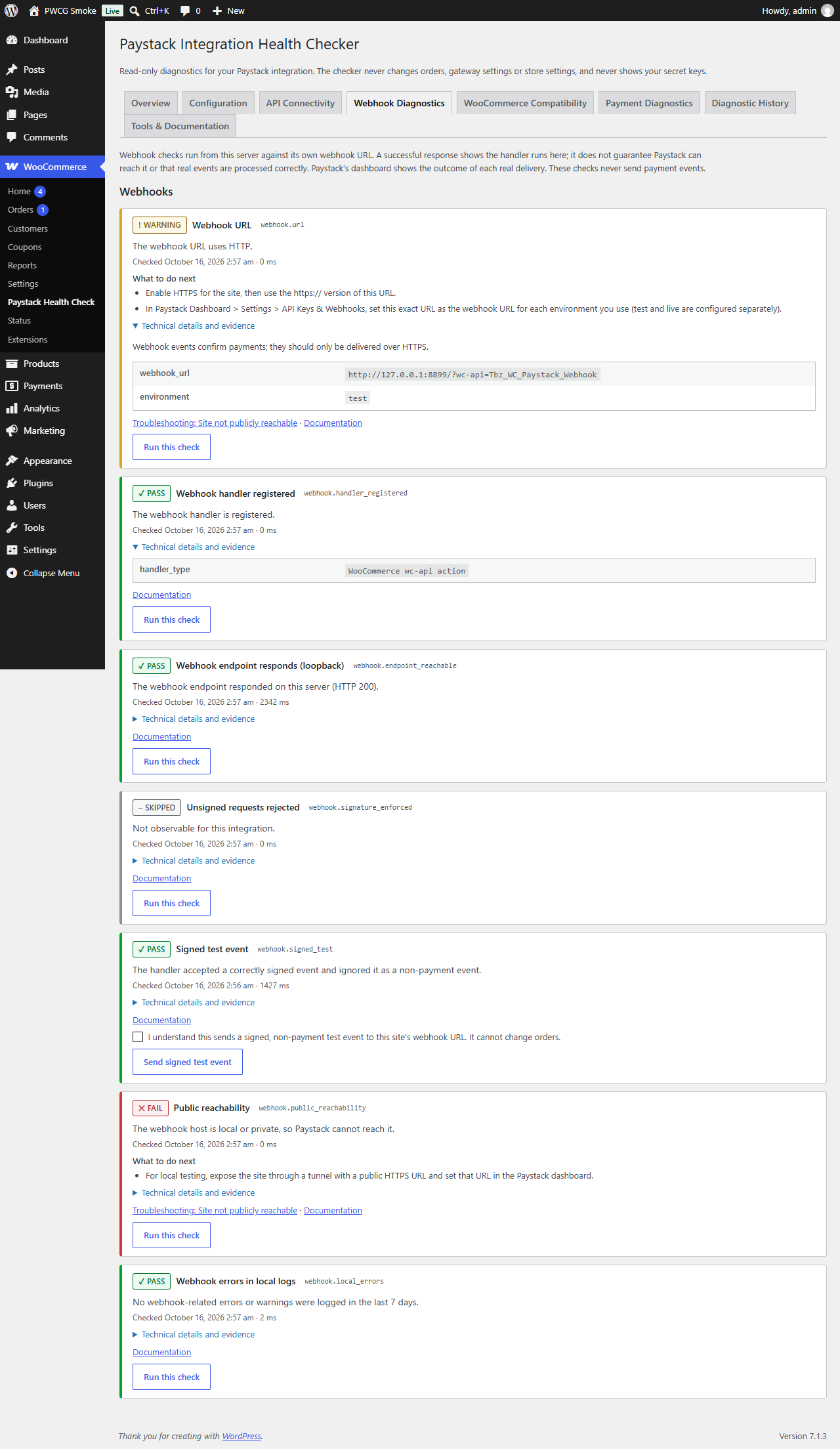
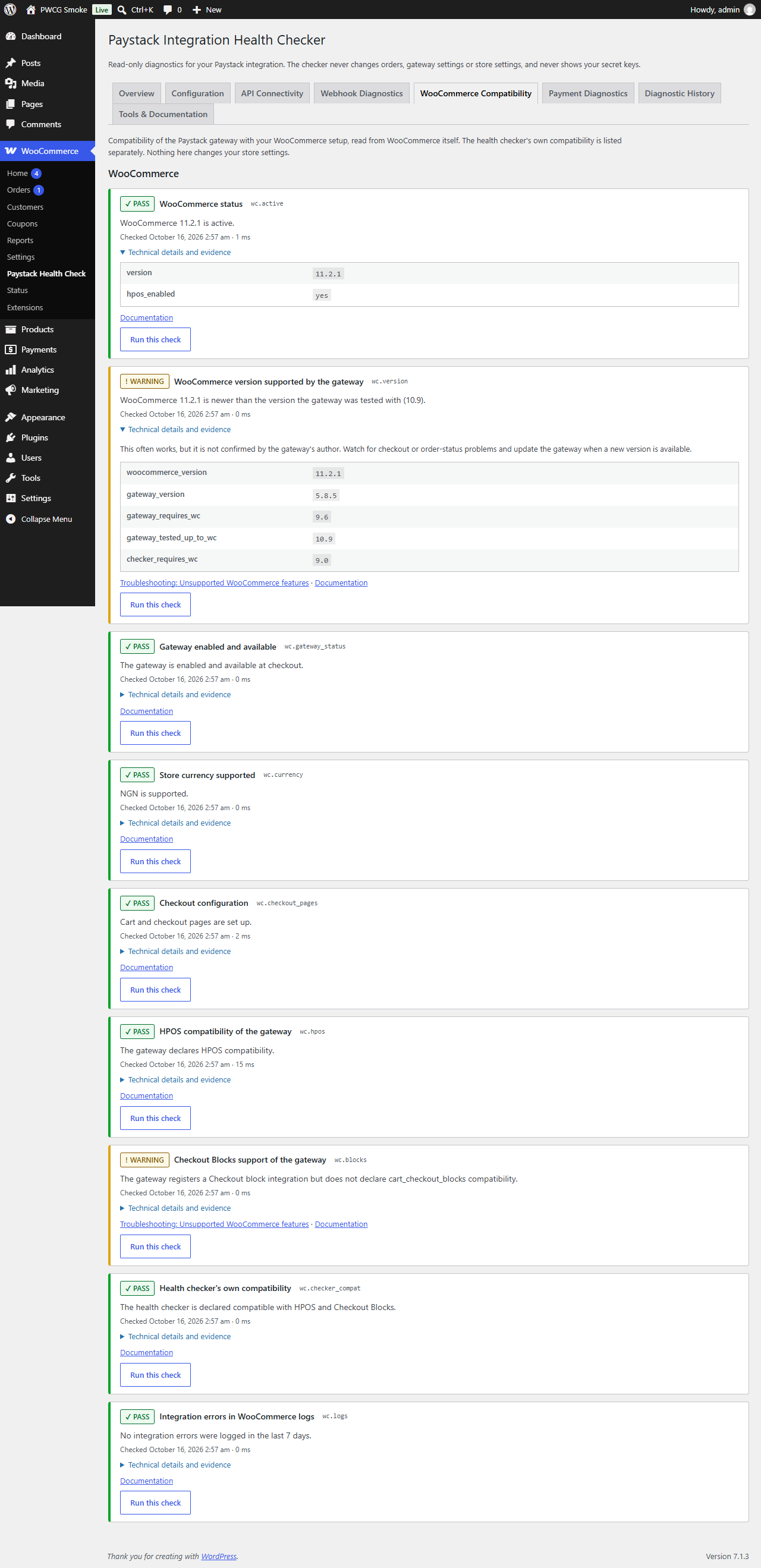
Captured from the actual plugin on WordPress 7.1.3 with WooCommerce 11.2.1 (headless Microsoft Edge, 2026-10-16). See §14 for how they were produced.
| Overview | Webhook Diagnostics |
|---|---|
 |
 |
| WooCommerce Compatibility | Payment Diagnostics |
 |
 |
| Diagnostic History | Configuration |
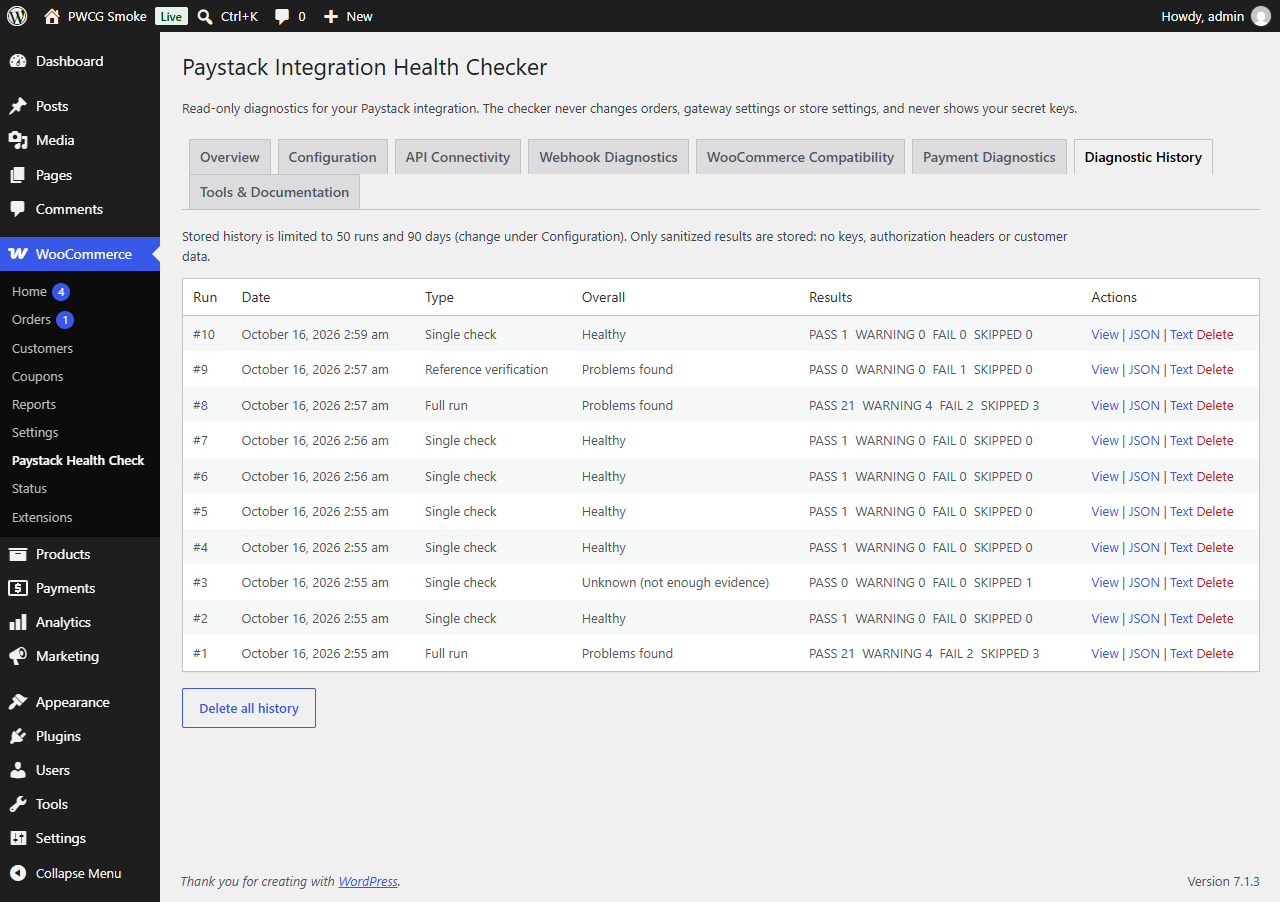 |
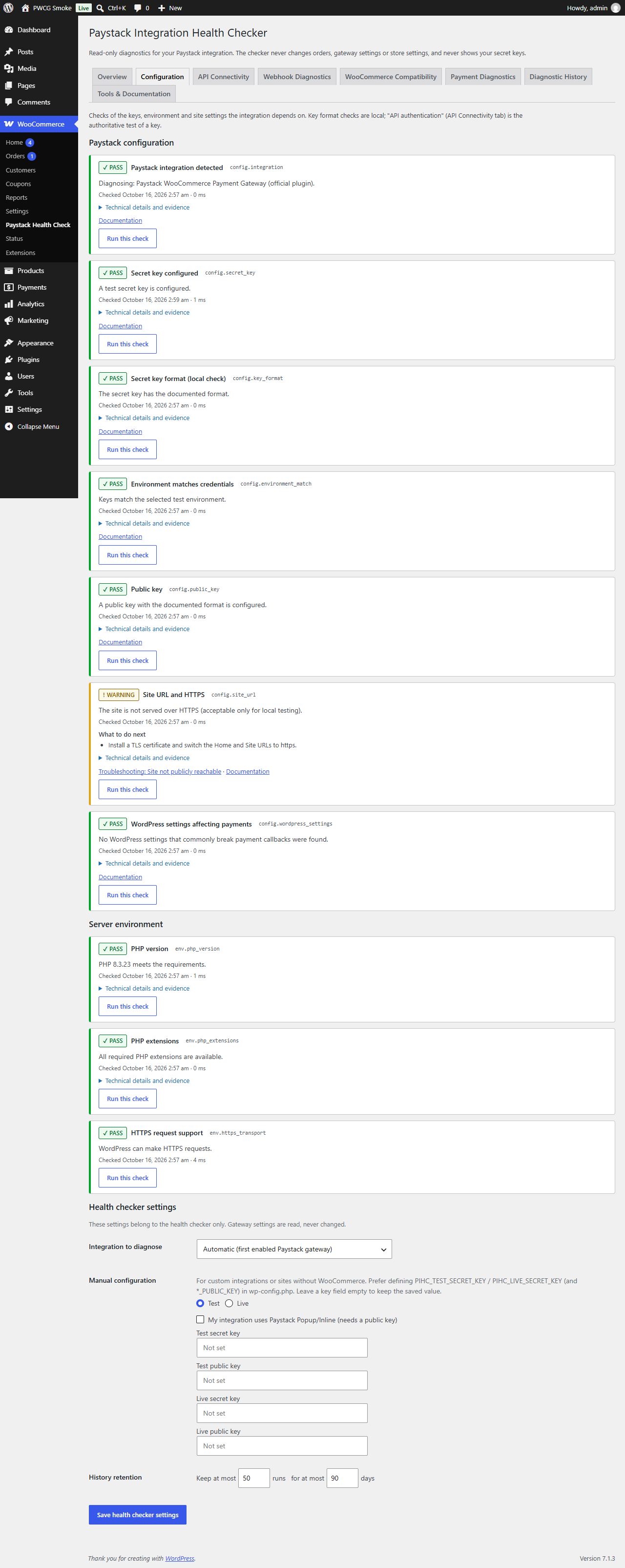 |
4. Architecture
paystack-integration-health-checker/
├── paystack-integration-health-checker.php   Header, constants, activation, WooCommerce feature declarations
├── uninstall.php                             Removes the checker's own settings, tables, transients, cron
├── includes/
│   ├── class-plugin.php               Composition root: builds services, registers hooks
│   ├── class-check-definition.php     Declarative check: id, name, category, callback, prerequisites, flags
│   ├── class-diagnostic-registry.php  Ordered registry; extensible via the pihc_register_checks action
│   ├── class-diagnostic-context.php   Per-run state: settings, selected integration, API factory, memo
│   ├── class-diagnostic-manager.php   Runs checks: prerequisites -> SKIPPED, error containment, redaction, storage
│   ├── class-diagnostic-result.php    Immutable result: status, summary, explanation, evidence, next steps, kb, doc, time
│   ├── class-health-summary.php       Counts, score, coverage, overall status
│   ├── class-diagnostic-history.php   Runs/results tables, trend, retention, deletion
│   ├── class-paystack-api-client.php  Read-only Paystack client (2 documented GET endpoints) + Api_Response
│   ├── class-reference-verifier.php   Payment Diagnostics: verify a reference, compare with an order
│   ├── class-report-exporter.php      Sanitized JSON / text reports
│   ├── class-redactor.php             Removes keys, tokens, e-mails, card-like numbers, sensitive keys
│   ├── class-security.php             Capability, nonces, throttling, own-site URL and private-host guards
│   ├── class-log-inspector.php        Read-only WooCommerce log scanning (file and DB handlers)
│   ├── class-troubleshooting.php      Knowledge base
│   ├── class-settings.php / class-installer.php / class-environment.php / class-autoloader.php
│   ├── integrations/                  Integration_Adapter interface; Official, Pwcg and Manual adapters; detector
│   ├── checks/                        Environment, Configuration, Connectivity, Webhook, WooCommerce, Payment_Flow
│   └── admin/                         Admin_Page (menu, settings, assets), Admin_Controller (actions), Result_Renderer
├── admin/views/ css/ js/              Templates (escaped output), styles, progressive-enhancement JS
├── bin/                               install-test-env.php, build-zip.php, lint-syntax.php
├── docs/DEVELOPER.md                  How to add a check
└── tests/                             unit/ (no WordPress), integration/ (WordPress + WooCommerce)
Design principles
- The registry drives everything. The dashboard, tabs, full run, history and exports all read from
Diagnostic_Registry, so adding a check means registering it and nothing else (see docs/DEVELOPER.md). - Adapters isolate integration specifics. Option names, gateway IDs, webhook endpoints and log sources live in one adapter per integration. Supporting another Paystack plugin, or another provider, means adding an adapter.
- Diagnostic logic is separate from presentation. Checks return
Diagnostic_Resultobjects and never output HTML.Result_Rendererrenders them for both page loads and AJAX responses, so escaping lives in one place. - The API client doesn't depend on the admin UI. It takes a key and a redactor and returns classified
Api_Responseobjects. - One run, one context. Related checks share one API probe and one loopback probe through the context memo, so a full run makes exactly one request to Paystack.
5. Requirements
| Component | Declared minimum | Actually tested |
|---|---|---|
| PHP | 7.4 | 8.3.23 runtime. PHP 7.4 syntax checked statically (PHPCompatibilityWP); not executed on 7.4. |
| WordPress | 6.5 (uses %i in $wpdb->prepare) |
7.1.3 |
| WooCommerce | Optional. 9.0+ for WooCommerce checks | 11.2.1, and without WooCommerce |
| Paystack gateways inspected | n/a | woo-paystack 5.8.5; paystack-woocommerce-gateway 1.0.0 |
| Database | MySQL/MariaDB | MariaDB (XAMPP) |
| PHP extensions | openssl, json, hash; curl recommended | All present |
Minimums below the tested versions are based on the APIs used, not on test runs.
6. Installation
From the ZIP (recommended): in WordPress go to Plugins → Add New Plugin → Upload Plugin, choose paystack-integration-health-checker-1.0.0.zip, then Install Now and Activate. Activation creates two tables and a daily retention job.
Where to find it:
- WooCommerce active: WooCommerce → Paystack Health Check
- No WooCommerce: Tools → Paystack Health Check
From source: git clone, then composer build (see §14), or copy the repository into wp-content/plugins/.
7. Configuration
Usually nothing is needed. With Integration to diagnose set to Automatic, the checker picks the first enabled supported Paystack gateway, or failing that the first active one, and reads its settings without changing them.
Under Configuration → Health checker settings you can set:
- Integration to diagnose: Automatic, a specific gateway, or Manual configuration.
- Manual configuration (custom integrations, or no WooCommerce): environment, whether you use Paystack Popup/Inline, and keys. Prefer
wp-config.phpconstants, which keep keys out of the database:define( 'PIHC_TEST_SECRET_KEY', 'sk_test_...' ); define( 'PIHC_LIVE_SECRET_KEY', 'sk_live_...' ); define( 'PIHC_TEST_PUBLIC_KEY', 'pk_test_...' ); // only if you use Popup/InlineSaved keys are never printed back; the form shows a masked hint such as
sk_test_…4567. Leave a field blank to keep the saved key, or tick Remove saved key. - History retention: at most N runs (5–500, default 50) and D days (1–365, default 90).
When a check finds something missing, its evidence includes a link to the settings page that fixes it.
8. Running diagnostics
- Run Diagnostics (Overview) runs every check in the full suite. The result is stored as a run and summarised on the dashboard.
- Run this check on any card re-runs just that check. The card updates in place, and the run is stored as a "single check" run, so the dashboard summary keeps showing the last full run.
- Buttons are disabled while a request is running (no duplicate submissions), a spinner shows progress, and the outcome is announced to screen readers.
- Throttling (per user): 3 full runs per minute, 15 single checks per minute, 10 reference verifications per minute.
- Everything works without JavaScript too: forms fall back to
admin-post.php.
9. Understanding diagnostic statuses
| Status | Meaning |
|---|---|
| PASS | The check ran and the requirement was satisfied. |
| WARNING | The check ran and found a potential problem: something that often causes failures, or evidence that is suggestive but not conclusive. |
| FAIL | The check ran and its evidence confirms a problem, e.g. Paystack answered HTTP 401 to the configured key, or the key prefix is for the other environment. |
| SKIPPED | The check could not be performed: a prerequisite was missing, the result isn't observable from outside, it would be unsafe, or the check hit an internal error. |
Confirmed failure vs potential issue. A result says FAIL only when its own evidence proves the problem. Examples:
- "The webhook URL returned HTTP 404" is a FAIL.
- "The site could not reach its own webhook URL" is only a WARNING, because many hosts block loopback requests while Paystack can still reach the site.
- "5 orders pending for over an hour" is a WARNING, because abandoned checkouts and missed webhooks look the same in order data.
When evidence can't identify a root cause, the result says so and lists the next checks to run.
Overall status and score
- Problems found: at least one FAIL. A single confirmed failure can't be averaged away by passing checks.
- Needs attention: no FAIL, at least one WARNING.
- Healthy: only PASS among the evaluated checks.
- Unknown: nothing could be evaluated.
- Score = round(100 × (PASS + 0.5 × WARNING) / evaluated). SKIPPED checks are excluded, so they can never inflate the score. The dashboard also shows coverage, the percentage of checks actually evaluated.
- A check that throws an exception or returns something invalid becomes SKIPPED ("could not be completed"), never PASS.
10. Safe test-mode payment verification
Payment Diagnostics → Verify a test transaction:
- Make sure the gateway is in test mode. The page warns if it's live; verification is still read-only, but you shouldn't test with real money.
- Place an order using one of Paystack's documented test cards (https://paystack.com/docs/payments/test-payments/).
- Copy the transaction reference from the Paystack dashboard or the order notes.
- Enter it, optionally with the order ID, and click Verify with Paystack.
The checker calls GET /transaction/verify/:reference with the integration's secret key and reports:
- Paystack's status (
success,failed,abandoned, ...), amount, currency, environment (domain), channel and gateway response. Customer, card, authorization and IP data from the response are discarded before anything is shown or stored. - With an order ID it compares both sides:
- Paystack success but the order isn't paid → FAIL ("payment not reflected in the order");
- amount or currency mismatch → FAIL (customer-borne fees are recognised when
requested_amountequals the order total); - a different reference stored on the order, or an order paid with a different payment method → WARNING;
- a transaction from the other environment → flagged.
The order is never modified. Tests assert that status, meta, notes and modification date are unchanged, and that no order hooks fire. Verification never relies on a browser redirect or a client-side message.
11. Understanding webhook checks
| Check | What it does | What it does not prove |
|---|---|---|
| Webhook URL | Generates the URL the integration expects, e.g. /?wc-api=Tbz_WC_Paystack_Webhook (official) or /wp-json/pwcg/v1/webhook; checks HTTPS |
That this URL is the one configured in your Paystack dashboard (the checker can't read it) |
| Handler registered | Confirms the wc-api action or REST route exists | That the handler works |
| Endpoint responds (loopback) | Unsigned, non-payment POST from the server to its own URL; interprets 404/400 (no handler), 5xx (handler error), 3xx (redirect, which Paystack won't follow), 401/403 | That Paystack's servers can reach it (DNS, firewalls and CDNs differ). A GET failure would prove nothing, so POST is used. |
| Unsigned requests rejected | REST handler answering 401 = signature enforced; 2xx = FAIL | Not observable for the official gateway, which answers 200 either way → SKIPPED, with an explanation of what its source code does |
| Signed test event (manual, needs confirmation) | Sends {"event":"pihc.diagnostic_ping"} signed with HMAC-SHA512 of the raw body and the configured secret key. The official handler returns -1 once the signature is accepted (empty body if rejected); pwcg returns 200 unsupported_event (401 if rejected) |
Processing of real charge.success events. The test event is deliberately not a payment event, so it can't mark orders paid or trigger fulfilment. |
| Public reachability | FAIL for localhost/private/reserved hosts; WARNING if unresolvable | For public hosts → SKIPPED: verifying would mean asking a third-party service to call your site, which the checker deliberately doesn't do. Use the Paystack dashboard's webhook delivery log. |
| Webhook errors in local logs | Counts webhook/signature warnings and errors written by the gateway (pwcg logs to pwcg-paystack; the official gateway doesn't log, so only WooCommerce fatal errors mentioning it are checked) |
Paystack-side delivery attempts. The checker has no access to Paystack's delivery logs. |
A reachable endpoint does not guarantee successful webhook processing. The interface says so next to these results.
12. Implemented checks
| ID | Name | Network | In full run |
|---|---|---|---|
env.php_version |
PHP version (vs plugin and gateway "Requires PHP") | – | ✓ |
env.php_extensions |
openssl, json, hash/SHA-512, curl | – | ✓ |
env.https_transport |
WordPress HTTP API can do HTTPS | – | ✓ |
config.integration |
Integration detected; multiple enabled Paystack gateways flagged | – | ✓ |
config.secret_key |
Secret key present for the active environment (masked hint) | – | ✓ |
config.key_format |
sk_test_/sk_live_ prefix, local check (public key in secret field = FAIL) |
– | ✓ |
config.environment_match |
Test mode ↔ test keys, live mode ↔ live keys (secret and public) | – | ✓ |
config.public_key |
Required only for Popup/Inline; secret key in a public field = FAIL (exposure) | – | ✓ |
config.site_url |
HTTPS (FAIL in live, WARNING in test); home/site URL host mismatch | – | ✓ |
config.wordpress_settings |
WP-Cron disabled, errors displayed in responses, maintenance mode | – | ✓ |
api.dns |
api.paystack.co resolves |
DNS only | ✓ |
api.authentication |
GET /integration/payment_session_timeout; full error classification |
Paystack | ✓ |
webhook.url |
Expected webhook URL, HTTPS | – | ✓ |
webhook.handler_registered |
wc-api action / REST route registered | – | ✓ |
webhook.endpoint_reachable |
Unsigned loopback POST, interpreted per integration | own site | ✓ |
webhook.signature_enforced |
Unsigned request rejected (where observable) | own site | ✓ |
webhook.signed_test |
Signed non-payment test event accepted | own site | manual only |
webhook.public_reachability |
Host not local/private | DNS only | ✓ |
webhook.local_errors |
Webhook warnings/errors in WooCommerce logs (7 days) | – | ✓ |
wc.active |
WooCommerce active / installed / absent | – | ✓ |
wc.version |
WooCommerce within the gateway's declared range | – | ✓ |
wc.gateway_status |
Gateway enabled and available at checkout | – | ✓ |
wc.currency |
Store currency accepted by the gateway and listed in Paystack's API docs | – | ✓ |
wc.checkout_pages |
Cart/checkout pages set, published, containing block or shortcode | – | ✓ |
wc.hpos |
Gateway's HPOS declaration as recorded by WooCommerce | – | ✓ |
wc.blocks |
Checkout block in use vs gateway block registration and declaration | – | ✓ |
wc.checker_compat |
The checker's own HPOS/Blocks declarations | – | ✓ |
wc.logs |
Gateway errors and fatal errors in WooCommerce logs (7 days) | – | ✓ |
flow.recent_orders |
This gateway's orders (30 days) by status | – | ✓ |
flow.stuck_orders |
Pending > 60 minutes | – | ✓ |
flow.paid_without_transaction |
Paid orders missing a transaction ID | – | ✓ |
flow.reference_verification |
Reference verification (Payment Diagnostics form) | Paystack | manual |
Real findings these checks produced against current software during development:
- woo-paystack 5.8.5 declares "WC tested up to: 10.9", so
wc.versionwarns on WooCommerce 11.2.1. - woo-paystack 5.8.5 registers Checkout block integrations but does not declare
cart_checkout_blocks, sowc.blockswarns. - It also accepts EGP and RWF, which aren't in the API documentation's currency table, so
wc.currencywarns for those.
13. Security model
| Concern | Control |
|---|---|
| Who can run diagnostics | manage_woocommerce when WooCommerce is active, otherwise manage_options (filter pihc_capability). Checked on the page and in every handler. |
| CSRF | A nonce per action (run, run check, verify reference, export, delete), verified before anything happens |
| Public exposure | No REST routes and no wp_ajax_nopriv_ handlers. Logged-in admin requests only. |
| SSRF / arbitrary URLs | The checker never requests a URL supplied by a user. Outbound requests go only to the fixed https://api.paystack.co base (two GET paths) or to URLs the site generates for itself, verified by Security::is_own_site_url() (same host and port, no credentials, http/https only). A test runs every check and asserts that every outbound request went to one of those two hosts. |
| Secrets | Keys never rendered (masked hints only), never sent to the browser, never logged, stored or exported. The Redactor removes sk_/pk_ tokens, bearer tokens, e-mail addresses, 13–19 digit numbers, sensitive keys, and the exact value of every key configured on the site. It is applied when results are stored and again on export. |
| Paystack TLS | sslverify stays on for API calls, as Paystack's docs require |
| Untrusted API responses | JSON decoded defensively. Only whitelisted scalar fields of a verified transaction are kept; messages are truncated and redacted. |
| Input | Check IDs must exist in the registry; references match ^[A-Za-z0-9.=-]{1,100}\z; IDs go through absint; tabs are whitelisted; settings are sanitized and clamped |
| Output | All HTML escaped in templates or Result_Renderer; downloads are sent with X-Content-Type-Options: nosniff |
| SQL | Every query uses $wpdb->prepare() (%i for identifiers) or $wpdb->insert/delete |
| Abuse / quota | Per-user throttling (a sliding window in transients). This guards against accidents and API quota use; it is not an authorization control. |
| Destructive operations | None during diagnostics. The signed test event is non-payment, own-site only, and needs explicit confirmation. Orders are only read. |
| Data minimisation | History stores results and a non-sensitive environment snapshot (versions, booleans, site host). Retention is bounded. Uninstall removes all checker data. |
This is a portfolio project. Before relying on it in production, get an independent security review and test it on a staging copy of your site.
14. Automated testing
No test touches a real Paystack account. Every outbound request must be mocked, and anything unmocked fails the test (tests/bootstrap.php).
composer install
php bin/install-test-env.php     # WordPress 7.1.3 + WooCommerce 11.2.1 + woo-paystack 5.8.5 (+ sibling pwcg project if present)

vendor/bin/phpunit -c phpunit-unit.xml.dist                    # 26 unit tests, no WordPress
vendor/bin/phpunit                                             # unit + integration (WooCommerce, both gateways)
PIHC_TESTS_WOOCOMMERCE=0 vendor/bin/phpunit --group no-woocommerce   # only the checker loaded
vendor/bin/phpcs                                               # WordPress, WooCommerce, PHP 7.4+ standards
php bin/lint-syntax.php
composer build                                                 # dist/paystack-integration-health-checker-1.0.0.zip
(On Windows PowerShell: $env:PIHC_TESTS_WOOCOMMERCE=0; vendor/bin/phpunit --group no-woocommerce.)
| Area | Test file | Highlights |
|---|---|---|
| Pure model | tests/unit/CoreModelTest.php |
Scoring and status rules (skipped never inflates; one FAIL can't be averaged away), redaction, transport-error classification, reference rules, field whitelisting, registry |
| Configuration | ConfigurationChecksTest |
Missing key, key format (local), environment mismatch, public-key rules incl. secret-in-public exposure, HTTPS rules, auto-detection, two enabled gateways |
| API | ConnectivityChecksTest |
Request shape (GET, Bearer, sslverify, timeout, no body); 401/403/429 (+ reset header)/5xx/timeout/DNS/TLS/refused/HTML/status:false/missing data; one API call per full run; never initializes transactions |
| Webhooks | WebhookChecksTest |
Interpretation of every response class; signed event signature correctness; SSRF guard (foreign URL → no request); localhost detection; log excerpts redacted; contract test against the real pwcg handler |
| WooCommerce | WooCommerceChecksTest |
Against the real woo-paystack 5.8.5 and pwcg: version range, enabled/hidden gateway, currencies, HPOS and Blocks declarations, checkout pages, logs; no settings changed by a full run |
| Payments | PaymentDiagnosticsTest |
Reference verification outcomes; order unchanged and no order hooks fired; customer, card and authorization data never stored; order-evidence checks |
| Runner/history | ManagerAndHistoryTest |
Error containment, prerequisites, redaction before storage, extension point, retention by count and age, trend, deletion |
| Security/export | SecurityAndExportTest |
Reports contain versions and a skipped section but no keys or PII; all outbound hosts; URL and host guards; throttling; settings sanitization |
| Authorization | AdminControllerTest |
Real admin-ajax: roles, missing/forged/wrong-action nonces, throttling (429), input validation, confirmation required for the signed event |
| Admin UI | AdminPageTest |
Every tab renders without printing keys; textual statuses; capability check; menu placement |
| No WooCommerce | NoWooCommerceTest (group no-woocommerce) |
Full run works, WooCommerce checks SKIPPED, manual keys enable API checks, menu under Tools |
Results of the runs during development (2026-10-16):
- 26 unit tests OK
- 200 full-suite tests OK, five consecutive runs
- 7 no-WooCommerce tests OK
- PHPCS: 0 errors, 0 warnings
Details are in the final implementation report.
Installation smoke test (2026-10-16), on a fresh WordPress 7.1.3 site with WooCommerce 11.2.1, woo-paystack 5.8.5 and paystack-woocommerce-gateway 1.0.0, using the built ZIP and no mocks:
-
Activation created both tables and the daily retention job; 31 checks were registered.
-
A full run sent a real
GET /integration/payment_session_timeoutto Paystack with a deliberately fake test key. Paystack answered HTTP 401 "Invalid key" (871 ms), reported as FAIL with the right guidance. -
Real loopback requests to both webhook handlers matched the behaviour inferred from their source code:
- official gateway: unsigned → 200 with an empty body; signed test event → 200 with body
-1→ PASS; - pwcg: unsigned → 401 → PASS for "Unsigned requests rejected"; signed test event → 200
unsupported_event→ PASS.
- official gateway: unsigned → 200 with an empty body; signed test event → 200 with body
-
An existing order was unchanged afterwards.
-
Real findings were reported: woo-paystack's tested-up-to WooCommerce version (10.9) and its missing
cart_checkout_blocksdeclaration, an HTTP site, and a private host that can't receive webhooks. -
A headless Microsoft Edge pass checked 25 things, all passing:
- every tab renders with no PHP errors and no key in the HTML;
- AJAX re-run updates the card in place and announces it in the live region;
- a double click sends only one request;
- the JSON report downloads with no key, and a forged-nonce download returns 403;
- the summary fits at 375 px;
- no JavaScript console errors.
The screenshots in §3 come from that run.
Not covered by automated tests:
- the admin JavaScript (exercised only in the browser smoke test);
- a real delivery of a Paystack webhook;
- PHP versions other than 8.3.
15. Known limitations and unverified scenarios
- No access to the Paystack dashboard: the checker cannot read the configured webhook URL, Paystack's webhook delivery log, IP-whitelist settings, or which currencies are enabled on the account. It says so in the relevant results.
- External reachability is not verified for public hosts (that would need a third-party callback service, which is deliberately not used).
- Loopback checks prove the handler responds on this server, not that Paystack can reach it. Hosts that block loopback produce WARNINGs.
- Official gateway signature enforcement cannot be observed from outside (identical responses). The checker relies on the signed test event plus documented source behaviour (version 5.8.5); later versions may differ.
- Adapter facts come from woo-paystack 5.8.5 and pwcg 1.0.0. Option names or endpoints changed by future versions would need adapter updates.
- HPOS and Blocks declarations are read through WooCommerce internals (
FeaturesController, BlocksPaymentMethodRegistry). They are guarded, so if a future WooCommerce changes them the checks report SKIPPED rather than crashing. - Payment stages not verifiable without a test payment: transaction initialization, the customer redirect/handoff, and duplicate-notification handling inside the gateway.
- Order evidence cannot distinguish abandoned checkouts from paid-but-unconfirmed orders; those results are WARNINGs and point to reference verification.
- Log inspection covers WooCommerce's file and database handlers only, and reads the last 256 KB of each recent file.
- Throttling uses transients and is not atomic under heavy concurrency.
- Not executed on PHP 7.4–8.2, older WordPress or WooCommerce, multisite, or the SQLite drop-in.
16. Troubleshooting
The Tools & Documentation tab contains the knowledge base. Each result links to its topic: credentials, key format, environment mismatch, timeouts, DNS, TLS, 401/403 (including IP whitelisting), 429, 5xx, wrong reference, amount/currency mismatch, verification failures, missing webhooks, invalid signatures, duplicate processing, orders not updating, plugin conflicts, unsupported WooCommerce features, the PHP environment, and non-public sites.
Problems with the checker itself:
- Every check SKIPPED: no integration was found. Activate a supported gateway or enter keys under Configuration.
- "Too many requests": you hit the per-user throttle; wait the number of seconds shown.
- Loopback warnings on every run: your host blocks requests from the server to itself. Use Paystack's webhook delivery log instead.
- Webhook errors in local logs: the default window is 7 days. Old errors stop appearing once the window has passed.
17. Future improvements
- Optional, opt-in external reachability check through a self-hosted probe.
- More adapters (other Paystack plugins, other payment providers) through
pihc_integration_adapters. - Scheduled diagnostics with e-mail alerts on new FAILs.
- A JavaScript test harness for the admin UI.
- A CI matrix across PHP 7.4–8.4 and older WordPress/WooCommerce versions.
- WP-CLI command (
wp pihc run --format=json).
License: GPL-2.0-or-later. See LICENSE.