Install
This is the repository archive. It installs, but the folder name will carry the branch suffix and updates will not flow.
Install straight from GitHub with WP-CLI:
wp plugin install https://github.com/basit95/wp-enterprise-content-hub/archive/refs/heads/main.zipEnterprise-oriented WordPress plugin demonstrating scalable plugin architecture, Gutenberg development, REST APIs, automated testing, coding standards, Docker-based local development, and CI/CD.
Features
- Custom
Resourcepost type - Custom
Departmenttaxonomy - REST API endpoints
- Search and department filtering
- React-based Gutenberg block
- Dynamic frontend resource explorer
- Custom WordPress capabilities
- Repository pattern
- Service layer architecture
- PHPUnit unit tests
- WordPress Coding Standards with PHPCS
- JavaScript and SCSS linting
- Docker-based local development
- GitHub Actions CI
- PHP 8.1, 8.2, and 8.3 CI validation
- Responsive grid and list layouts
Screenshots
Enterprise Resource Explorer
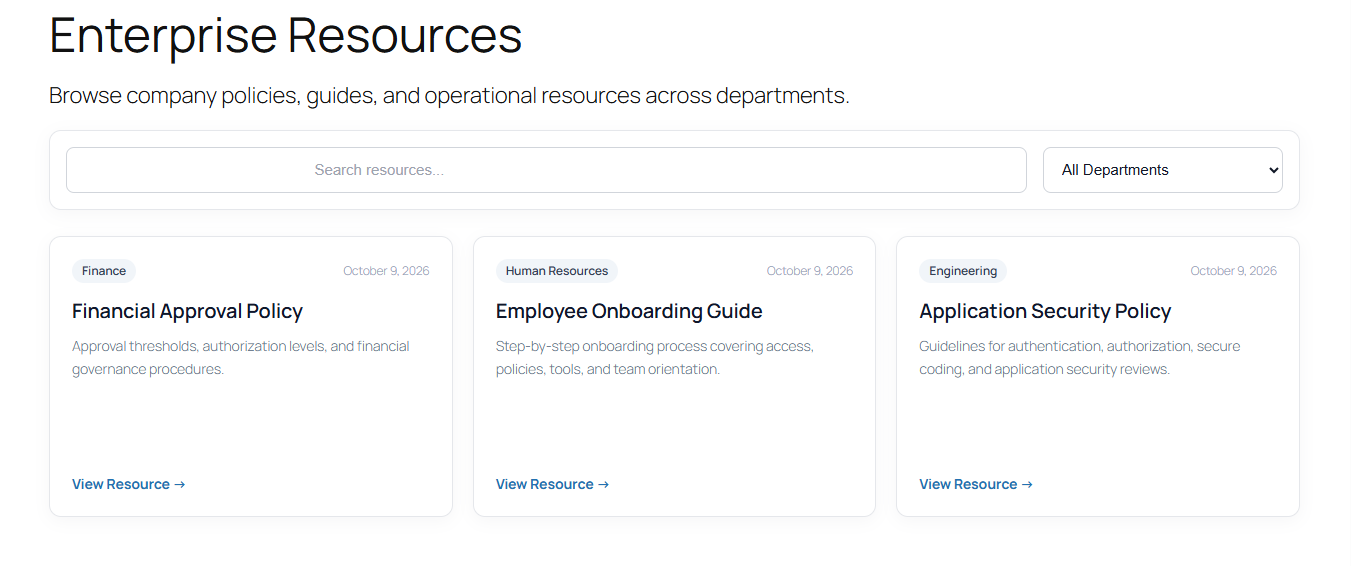
Searchable and filterable frontend resource directory with department metadata, responsive resource cards, and dynamic filtering.
Gutenberg Block Editor
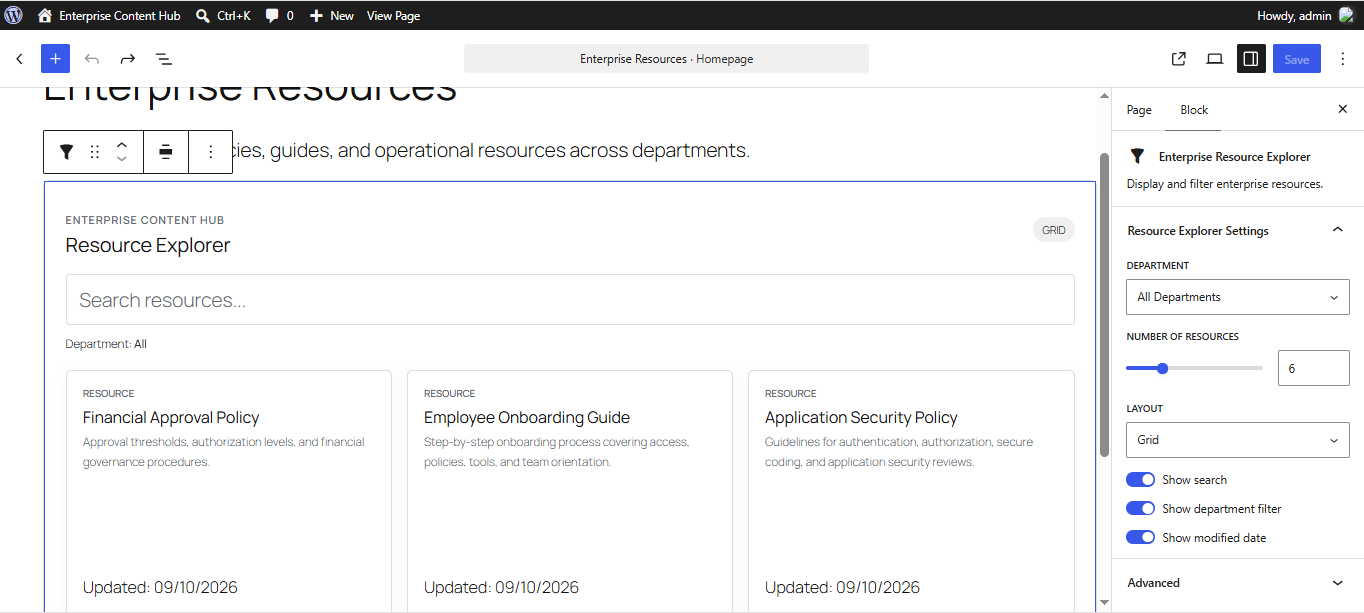
Custom React-based Gutenberg block with configurable department, number of resources, layout, search visibility, department filtering, and modified date controls.
REST API
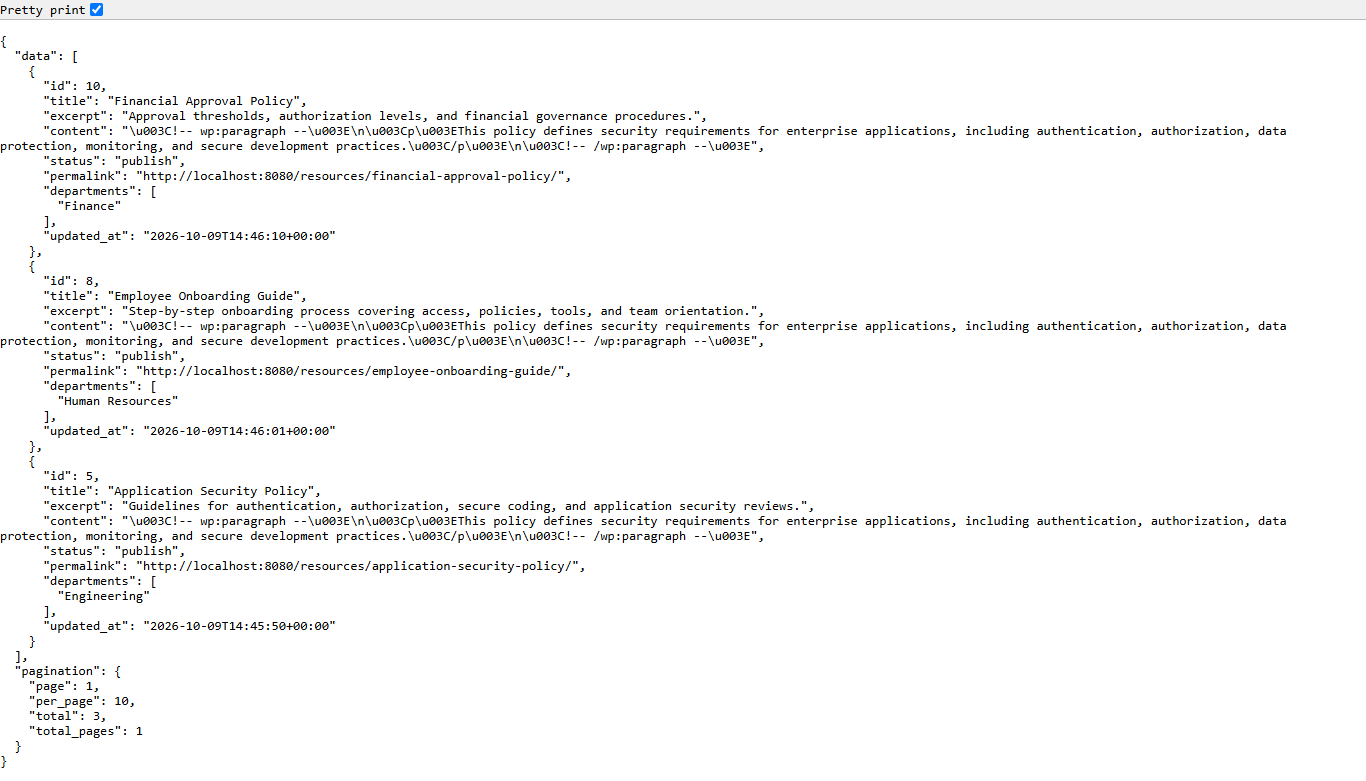
Custom REST API exposing enterprise resources with structured response data and pagination metadata.
Department Filtering
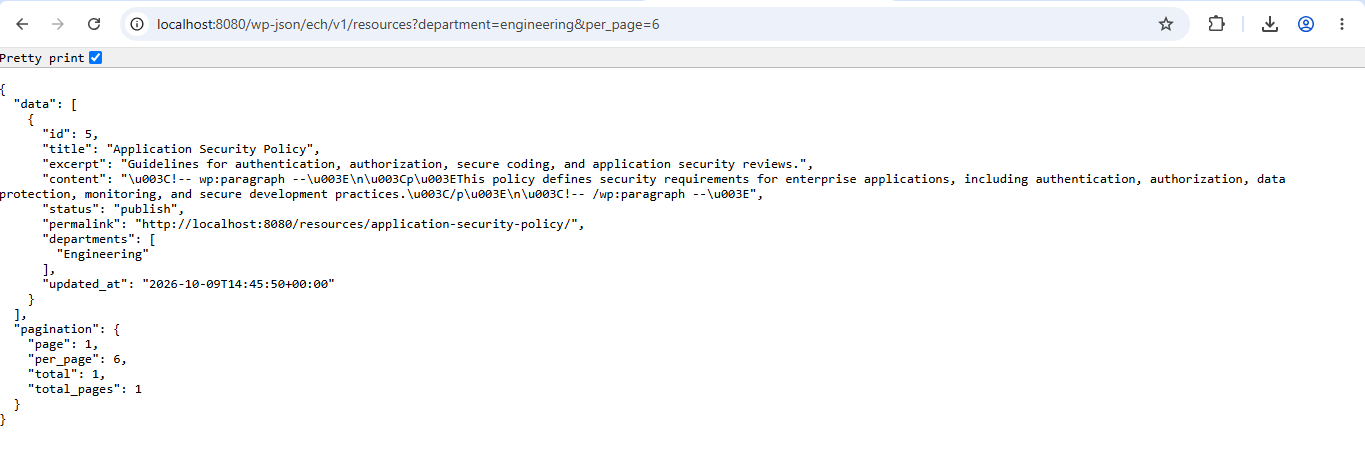
REST API filtering resources by department using the custom department query parameter.
GitHub Actions CI
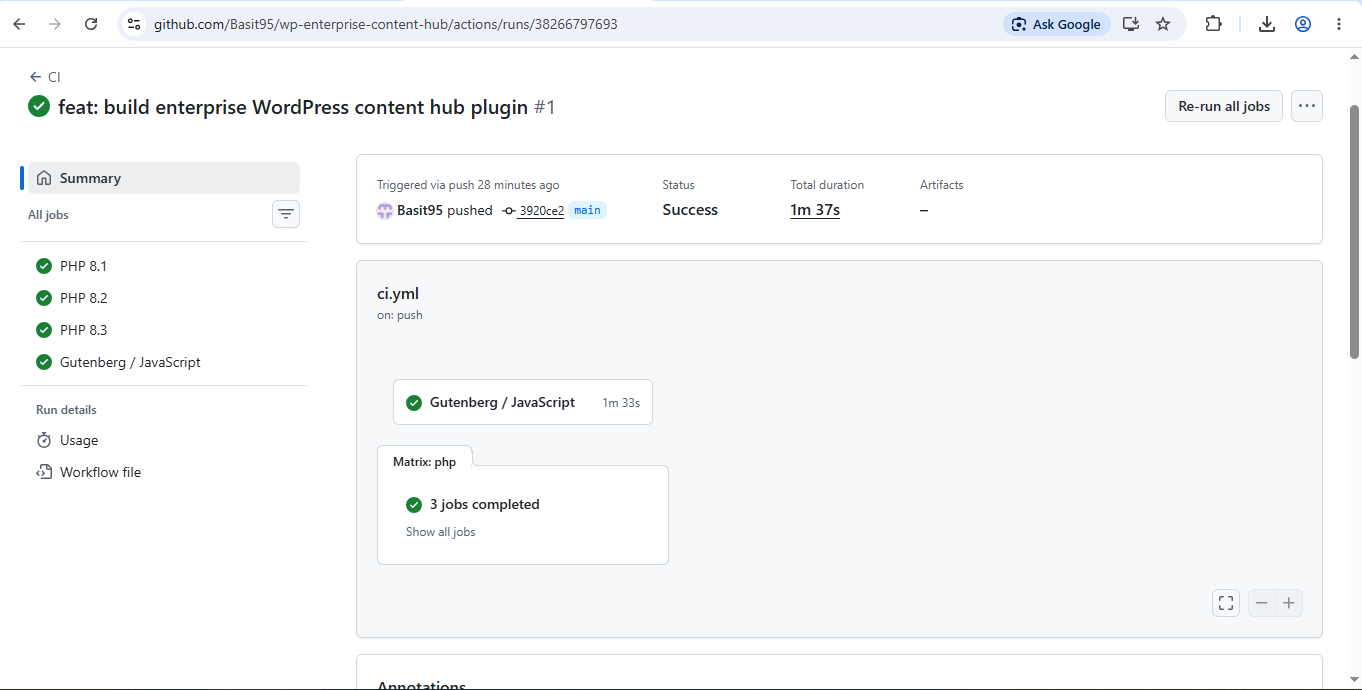
Automated CI pipeline validating PHP 8.1, PHP 8.2, PHP 8.3, PHPUnit, PHPCS, JavaScript, SCSS, and Gutenberg production builds.
Architecture
The plugin separates WordPress-specific infrastructure from application and domain logic to improve maintainability, testability, and extensibility.
src/
├── Application/
│   └── ResourceQuery.php
├── Blocks/
│   └── ResourceExplorerBlock.php
├── Content/
│   ├── ResourcePostType.php
│   └── ResourceTaxonomy.php
├── Contracts/
│   └── ResourceRepository.php
├── Domain/
│   └── Resource/
│       └── Resource.php
├── Infrastructure/
│   └── WordPressResourceRepository.php
├── Lifecycle/
│   ├── Activator.php
│   └── Deactivator.php
├── Rest/
│   ├── DepartmentController.php
│   └── ResourceController.php
├── Security/
│   └── Capabilities.php
├── Services/
│   └── ResourceService.php
└── Plugin.php
Request Flow
Gutenberg Block / REST Request
            ↓
     ResourceController
            ↓
      ResourceService
            ↓
   ResourceRepository
            ↓
WordPressResourceRepository
            ↓
        WP_Query
The ResourceRepository contract allows the application layer to remain independent from direct WordPress query implementation details.
This also makes the service layer easier to test with fake repository implementations.
REST API
Base namespace:
/wp-json/ech/v1Available endpoints:
GET /resources
GET /resources/{id}
GET /departments
Resource Collection
GET /wp-json/ech/v1/resourcesSupported query parameters:
| Parameter | Description |
|---|---|
search |
Search resources by keyword |
department |
Filter by department slug |
page |
Pagination page number |
per_page |
Resources per page, maximum 50 |
Example:
/wp-json/ech/v1/resources?search=security&department=engineering&page=1&per_page=6Example response structure:
{
  "data": [],
  "pagination": {
    "page": 1,
    "per_page": 6,
    "total": 0,
    "total_pages": 0
  }
}
Departments
GET /wp-json/ech/v1/departmentsReturns available resource departments including IDs, names, slugs, and resource counts.
Gutenberg Block
The plugin includes a custom block:
Enterprise Resource ExplorerThe block provides:
- Department selection
- Configurable resource count
- Grid and list layouts
- Search visibility control
- Department filter visibility control
- Modified date visibility control
- Editor preview
- Dynamic frontend filtering
- Responsive frontend rendering
Source files are located in:
blocks/resource-explorer/Production assets are generated into:
build/resource-explorer/Security
The plugin includes:
- Custom WordPress capabilities
- Sanitized REST API parameters
- Validated pagination parameters
- Escaped frontend output
- Published-resource visibility rules
- Capability assignment during plugin activation
Custom capabilities are managed through:
src/Security/Capabilities.phpRequirements
- WordPress 6.6+
- PHP 8.1+
- Composer
- Node.js 22
- npm
- Docker Desktop
Installation
Clone the repository:
git clone https://github.com/Basit95/wp-enterprise-content-hub.gitEnter the project directory:
cd wp-enterprise-content-hubInstall PHP dependencies:
composer installInstall JavaScript dependencies:
npm installBuild Gutenberg assets:
npm run buildStart the local WordPress environment:
docker compose up -dOpen:
http://localhost:8080Complete the WordPress installation and activate:
WP Enterprise Content Hubfrom the WordPress Plugins screen.
Development
Run the Gutenberg development watcher:
npm run startBuild production assets:
npm run buildThe build process:
- Compiles the Gutenberg editor bundle
- Generates editor and frontend CSS
- Generates WordPress asset metadata
- Copies
block.json - Copies the frontend interaction script
Testing
Run PHPUnit:
composer testCurrent unit tests cover:
- Resource domain model
- Resource serialization
- Resource query defaults
- Pagination boundaries
- Resource service behavior
- Invalid resource IDs
- Repository abstraction
- Pagination metadata
The project currently includes:
11 tests
30 assertions
PHP Coding Standards
Run PHPCS:
composer lintAutomatically fix supported violations:
composer lint:fixThe project uses WordPress Coding Standards while retaining PSR-4 class organization.
JavaScript Quality
Run JavaScript linting:
npm run lint:jsRun SCSS linting:
npm run lint:cssAutomatically fix supported SCSS issues:
npm run lint:css:fixFormat Gutenberg source files:
npm run formatLocal Quality Gate
Before committing changes, run:
composer lint
composer test
npm run lint:js
npm run lint:css
npm run build
All checks should pass before code is pushed.
GitHub Actions CI
The repository includes an automated GitHub Actions workflow.
CI runs on pushes and pull requests and validates:
PHP
- PHP 8.1
- PHP 8.2
- PHP 8.3
- Composer configuration
- Dependency installation
- PHPCS
- PHPUnit
Gutenberg / JavaScript
- Node.js 22
- npm dependency installation
- JavaScript linting
- SCSS linting
- Gutenberg production build
- Generated asset verification
Workflow configuration:
.github/workflows/ci.ymlDocker Development Environment
The repository includes a Docker Compose environment containing:
- WordPress
- MySQL 8
- WP-CLI
Start:
docker compose up -dStop:
docker compose downView containers:
docker compose psProject Structure
wp-enterprise-content-hub/
├── .github/
│   └── workflows/
│       └── ci.yml
├── blocks/
│   └── resource-explorer/
├── build/
│   └── resource-explorer/
├── docs/
│   └── images/
├── scripts/
│   └── copy-block-assets.mjs
├── src/
├── tests/
├── composer.json
├── composer.lock
├── docker-compose.yml
├── enterprise-content-hub.php
├── package.json
├── package-lock.json
├── phpcs.xml.dist
├── phpunit.xml.dist
└── README.md
Engineering Goals
This project demonstrates WordPress engineering beyond traditional theme and simple plugin development.
The main goals are:
- Modular architecture
- Separation of concerns
- Dependency inversion
- Repository pattern
- Service layer design
- Testable business logic
- REST API design
- Modern Gutenberg development
- Automated code quality
- Reproducible local development
- Continuous integration
- Production-oriented project organization
Release
Current stable release:
v1.0.0License
GPL-2.0-or-later
Releases
2 releases.
These releases are tags only. The author does not attach a packaged zip, so there are no download counts to report.