Install
This is the repository archive. It installs, but the folder name will carry the branch suffix and updates will not flow.
Install straight from GitHub with WP-CLI:
wp plugin install https://github.com/allterraindeveloper/allterrain-work/archive/refs/heads/main.zip
AllTerrain Work
Kanban project and task boards for the OpenStation desktop — a Monday-shaped work tracker built on ordinary WordPress objects.
What it is
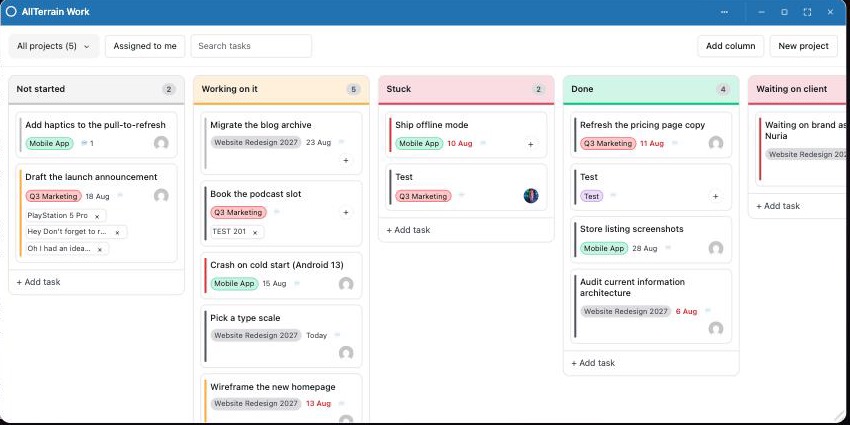
A board with a column per status and a card per task. Drag a card between columns and it moves — drop it on another card and the pointer's height picks its place. Filter by project, by "assigned to me", or by typing. Add tasks inline at the foot of any column.
Two decisions shape everything else.
It is a native OpenStation window, never an iframe
The board renders into the shell's own DOM. That is what gives it wp.os.dragManager —
the same pointer pipeline the desktop's file tiles ride — so a page dragged out of WP
Explorer can be dropped onto a card and attached, and a card lifted here carries the
payload type allterrain-work/task for any other plugin to receive. None of that is
reachable from inside an iframe.
Everything is a post
A project is a post, a task is a post, a status is a term, a comment is a comment.
Nothing lives in a bespoke table, so the REST API, current_user_can(), revisions,
autosave, search, the trash, the Comments screen and every plugin hooking save_post
already work on this data. The WordPress Abilities API is registered on top, so an AI
assistant or MCP client can create, move, assign, attach and comment through fourteen
typed, permission-checked abilities.
With OpenStation absent or switched off, the same bundle renders on a plain wp-admin page under Work. Cards still drag between columns; what they cannot do is leave the page, because there is nothing to leave it for.
A card
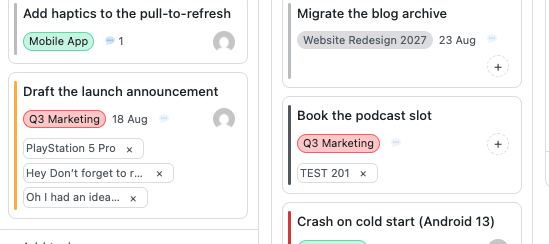
Each card carries a coloured project chip, a due date that turns red when it passes, a priority stripe down its leading edge, a 💬 count, an assignee avatar you can press, and a chip per attached item.
| Drop this | Here | And |
|---|---|---|
| A card | Anywhere in a column, including on another card | It moves |
| A post / page / media / CPT | On a card | It is attached |
| A user | On a card | It is assigned |
| Anything that is not a task | On a column | Refused, visibly |
A column takes tasks and nothing else. A column is a status, so a task is the only thing that can be in one. Content belongs on a card, where it attaches.
Assigning
Three ways, because one of them being a drag gesture is not enough:
- Click the avatar on any card — a searchable picker of people who can actually be assigned work. Unassigned cards show a dashed +, so the affordance is visible without hovering.
- The Gutenberg sidebar — the Work panel's Assignee field.
- Drag a user tile onto a card from WP Explorer.
The picker lists users holding edit_posts, not the whole user list: assigning work to
somebody who cannot open it is a way of losing the work, and a picker listing a thousand
subscribers is a picker nobody can use.
Comments
Every card has a 💬 button — always, even at zero, because a thread you can only find once somebody else has started it is a thread nobody starts. Enter sends, Shift+Enter breaks the line.
The thread is ordinary WordPress comments, so it is the same rows the admin's Comments screen moderates and OpenStation's Comments window lists.
Attaching things
Drag anything that lives in wp_posts onto a card — a post, a page, an image, a product,
a custom type nobody has written yet — and it is attached and shown with a link to it.
Attachments are stored as a list of post ids, which is why one field covers every type.
Detaching removes the link, never the thing. Same principle one level up: trashing a project keeps its tasks, and since the project is only trashed, restoring it brings the board back intact.
Fields, in the editor
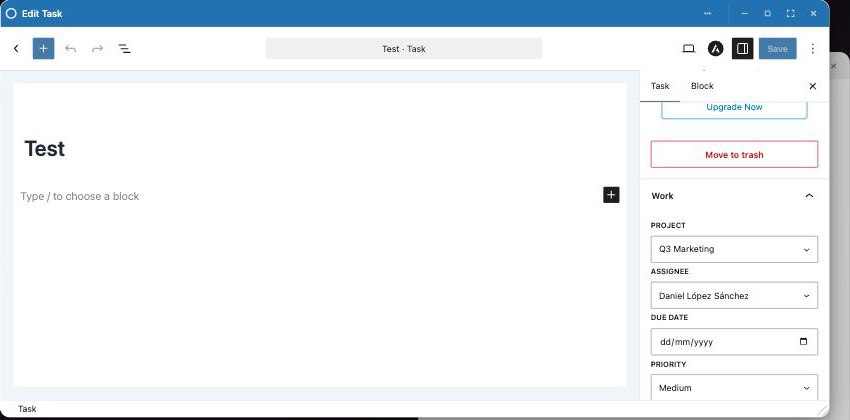
| Task | Project |
|---|---|
| Project, Assignee, Due date, Priority | Lead, State, Starts, Target, Colour |
The panel is written against the wp.* globals rather than importing @wordpress/*, so
it adds no second copy of React to a plugin that also loads where the editor does not
exist. A project's Colour is worn by its chips on the board.
WP Explorer
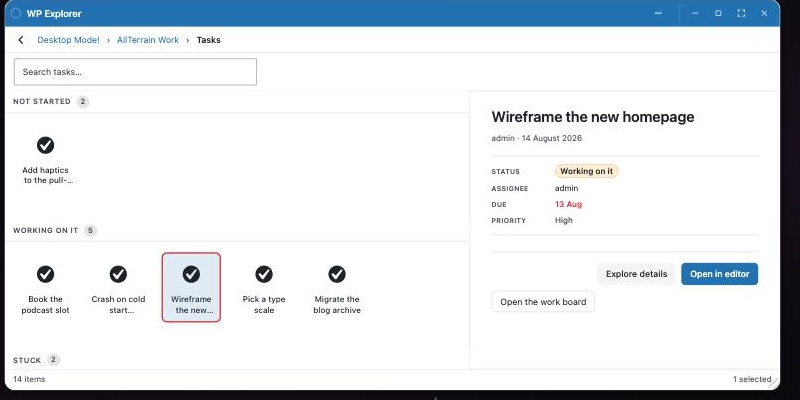
Both post types share one AllTerrain Work folder with per-section icons. Inside it the Explorer is decorated through its own documented seams:
| Seam | What it does |
|---|---|
preview-extras (meta) |
Status, assignee, due, priority — and for a project, state, lead, dates and colour |
preview-extras (footer) |
Open this project on the board — opens the board already filtered to it |
list-bands |
The Tasks grid is banded by status column, so the folder has the board's shape |
list-tile |
Overdue tasks are ringed, so late work is visible before you click it |
get_the_excerpt |
Tile summaries read Stuck · Ana · Overdue 10 Aug |
Two things are load-bearing and easy to get wrong. The section must declare listFields,
or the window's _fields list strips the meta and the status off every row. And the
status arrives under the taxonomy's rest_base (atwork-statuses), not its slug — asking
for the slug is answered with silence.
Staying live
The board and the widget subscribe to OpenStation's own content-change topics —
os.atwork-task.changed and os.atwork-project.changed. Changes arrive three ways:
instantly from this browser, instantly from a Gutenberg save, and within one Heartbeat
tick from any other tab or any other user. Rename a project in the editor and every chip
and dropdown on the board follows without a reload.
Moves are the one mutation the framework cannot see for itself — dropping a card writes
menu_order straight through $wpdb to avoid a revision per card, which fires no
save_post — so atwork_record_change() reports them by hand.
Requirements
- WordPress 6.0+
- PHP 7.4+
- OpenStation — required. Declared as
Requires Plugins: desktop-mode, so WordPress 6.5+ will not activate this plugin without it. The board is a native window on the desktop and every drag gesture in it is the shell's pointer pipeline; there is no version of this that works alone. - The Abilities API (optional — WordPress 6.9+, or any plugin that bundles it)
Install
Install OpenStation first, then grab the zip from Releases and upload it at Plugins → Add New → Upload Plugin — the built bundles are in the package, so there is nothing to compile.
To work on it instead:
git clone https://github.com/AllTerrainDeveloper/allterrain-work
cd allterrain-work
npm install
npm run build          # all bundles (dev + min), then deploys to a sibling WP checkout
Activate AllTerrain Work on the Plugins screen. Activation seeds four statuses — Not started, Working on it, Stuck, Done — if the site has none.
Commands
npm run build            # all bundles, then deploy
npm run dev              # watch-build the board bundle
npm run typecheck        # tsc --noEmit
npm test                 # vitest
npm run test:php         # PHPUnit
npm run lint:php         # WordPress Coding Standards

npm run env:start        # wp-env, for the PHP suite and Plugin Check
npm run plugin:package   # -> dist/allterrain-work.zip
npm run plugin:check     # WordPress.org's own Plugin Check
npm run plugin:release   # build + check + package, the full gate
Testing
141 PHPUnit tests and 72 vitest tests, all green, plus phpcs clean against the WordPress
Coding Standards.
npm run test:php needs a WordPress test library and a MySQL server, neither of which is
in this repository. It finds them in whichever environment is actually up — the local
docker-compose QA site if it is running, otherwise wp-env
from .wp-env.json — and skips with a note when neither is. One command rather than one
per environment, so the suite cannot quietly stop being run on either.
.wp-env.json mounts the repo with mappings rather than listing it under plugins,
which would make wp-env activate it. It can't: the plugin requires OpenStation, and a
bare wp-env has none, so WordPress refuses and wp-env start fails before any test runs.
Mounted inactive everything still works — the PHPUnit bootstrap loads the plugin itself,
and Plugin Check reads files.
Releasing
npm run plugin:package stages the tree, checks that all four places carrying the version
agree, and writes dist/allterrain-work.zip. What ships is decided in one place —
bin/ships.mjs — which both the packager and Plugin Check read, so the check can never be
blind to something the zip does contain. Nothing beginning with a dot ever ships.
Pushing a vX.Y.Z tag runs release.yml: it verifies the
tag against the plugin header, ATWORK_VERSION, readme.txt's Stable tag and
package.json, runs Plugin Check, attaches the zip to a GitHub Release, and deploys stable
tags to WordPress.org. Prereleases (v1.0.0-rc1) stop at the GitHub Release.
The desktop surfaces
| Surface | What it is |
|---|---|
Native window allterrain-work |
The board. Dock tile + desktop icon |
Widget allterrain-work/my-work |
Your open tasks, soonest first, with a project picker |
Command allterrain-work |
"Work: open the board" in the palette |
Drag payload allterrain-work/task |
What a lifted card carries; data.task is the full task |
Accepting a dropped card from another plugin:
wp.os.dragManager.registerDropTarget( {
    id: 'my-plugin/schedule',
    element: myCalendarEl,
    accept: ( payload ) => payload.type === 'allterrain-work/task',
    acceptLabel: 'Schedule this task',
    onDrop: ( session ) => {
        const { task } = session.payload.data;
        console.log( task.title, task.due );
    },
} );
Hooks
// Content
apply_filters( 'atwork_default_statuses', $statuses );        // seeded columns
apply_filters( 'atwork_done_status_slugs', array( 'done' ) ); // what counts as finished
apply_filters( 'atwork_status_palette', $colours );           // colours new columns cycle through
apply_filters( 'atwork_task_summary_parts', $parts, $post );  // the WP Explorer tile summary
apply_filters( 'atwork_assignee_query', $args, $search );     // who can be assigned work

// Surfaces
apply_filters( 'atwork_needs_admin_page', $needed );          // force the wp-admin board back on
apply_filters( 'atwork_script_config', $config );             // what the bundles receive
apply_filters( 'atwork_editor_config', $config, $type );      // what the Gutenberg panel receives

// Lifecycle
do_action( 'atwork_task_created', $task_id, $task );
do_action( 'atwork_task_updated', $task_id, $task );
do_action( 'atwork_task_moved', $task_id, $status_id, $task );
do_action( 'atwork_task_attached', $task_id, $ids );
do_action( 'atwork_task_commented', $comment_id, $task_id );
do_action( 'atwork_project_created', $post_id, $project );
do_action( 'atwork_project_trashed', $project_id );
do_action( 'atwork_status_created', $term_id, $status );
do_action( 'atwork_abilities_registered' );
REST
Both post types are show_in_rest, so /wp/v2/atwork-tasks and /wp/v2/atwork-projects
handle ordinary CRUD including meta. The plugin's own namespace covers what core cannot
express in one round trip:
| Route | Why it exists |
|---|---|
GET /allterrain-work/v1/board |
Columns, projects and cards together — the board cannot paint from any two |
POST /allterrain-work/v1/tasks/<id>/move |
A status change and a column reorder as one atomic write |
GET /allterrain-work/v1/my-work |
One person's queue, sorted by urgency |
GET /allterrain-work/v1/projects/<id> |
A project's counts, per-column breakdown and members |
POST /allterrain-work/v1/statuses |
Add a board column without leaving the board |
GET /allterrain-work/v1/assignees |
Searchable list of people who can be assigned work |
GET/POST /allterrain-work/v1/tasks/<id>/comments |
The task's discussion |
POST/DELETE /allterrain-work/v1/tasks/<id>/links |
Attach and detach |
Abilities
Registered under the allterrain-work category when the Abilities API is present:
list-projects · list-statuses · list-tasks · create-project · create-status ·
create-task · update-task · move-task · my-work · trash-task · attach-to-task ·
detach-from-task · trash-project · comment-on-task
Each is a thin wrapper over the same helper the board uses, so an agent moving a card and a person dragging one reach identical code — including the permission check.
Layout
allterrain-work.php          bootstrap: constants, requires, activation
includes/
  shell-api.php              resolves openstation_* / desktop_mode_* spellings
  content-types.php          post types, status taxonomy, task + project meta
  helpers.php                the real API: read the board, create, move, attach, comment
  rest.php                   the board-shaped routes
  abilities.php              fourteen WordPress Abilities over the same helpers
  assets.php                 script + style handles, mtime cache-busting, config
  admin-page.php             the Work menu; the no-shell fallback page
  editor.php                 enqueues the Gutenberg sidebar panel
  explorer.php               WP Explorer folder, icons, tile summaries, banding fields
  openstation.php            native window, desktop icon, widget, command
src/
  index.ts                   board entry — native window + admin page
  board.ts                   the board itself
  widget.ts                  the My Work desktop widget
  editor.ts                  the Gutenberg document sidebar panel
  explorer.ts                WP Explorer previews, banding and tile marks
  dnd.ts                     shell drag manager, and a fallback with its interface
  desktop-drops.ts           reading what the desktop dropped on a card
  assignee-picker.ts         the searchable assign popover
  comments.ts                the task thread
  os-ui.ts                   <os-select> / <os-button> where the shell provides them
  open.ts                    links open desktop windows, not browser tabs
  inline-ui.ts               ask / confirm / notice — never a browser modal
  focus.ts                   cross-bundle "show me this project" hand-off
  api.ts                     REST client + the content-change subscription
  dates.ts                   due-date arithmetic, shared by board and widget
  types.ts                   wire shapes, twinned with includes/helpers.php
A note on the post type names
atwork-project and atwork-task, not allterrain-work-*. register_post_type() caps a
key at 20 characters and allterrain-work- is 16 of them, so the longer name would fail
registration outright. The taxonomy cap is 32; atwork-status keeps the prefix for
consistency rather than necessity.
License
GPL-2.0-or-later. See LICENSE.